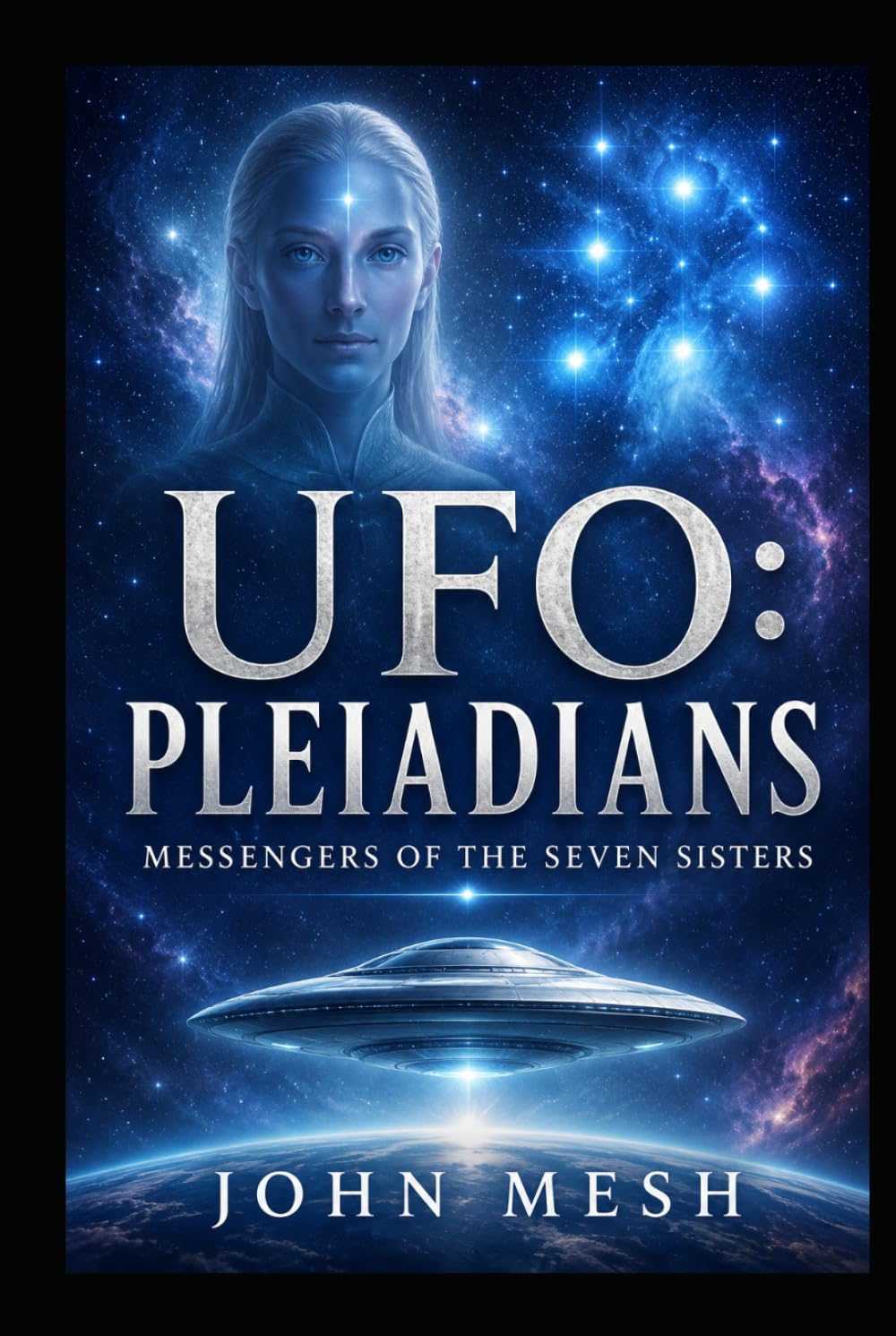
For thirty thousand years, humanity has looked at one small cluster of stars and seen family. Every culture on Earth — Greek, Aboriginal, Andean, Japanese, Māori — told stories about the Seven Sisters of the Pleiades: celestial maidens, lost kin, watchers in the night sky. Then, in 1975, in a Swiss meadow, the oldest story in the world took an astonishing new form. A one-armed farmer named Billy Meier claimed that a woman from those very stars had landed — and the modern myth of the Pleiadians was born. Who are the Pleiadians said to be? Where does the famous "Nordic" archetype come from? What do the contact reports, the channeled messages and the starseed movement really claim — and what does the actual astronomy of the Pleiades say in reply? In this rigorous and elegantly written investigation, John Mesh traces the complete arc of the Pleiadian phenomenon: the real star cluster, the ancient myths, the contactee era, the Meier case and Semjase, the described worlds and technologies, the message to Earth, the starseed identity and the crowded cosmos of modern ufology — always distinguishing verified fact from myth, testimony from hypothesis, and speculation from evidence. Neither a believer's manifesto nor a debunker's dismissal, UFO: Pleiadians asks the deeper question: why does this myth, of all myths, work so profoundly on the human heart? The answer is written in the stars — and in the species that has never stopped looking up at them.