

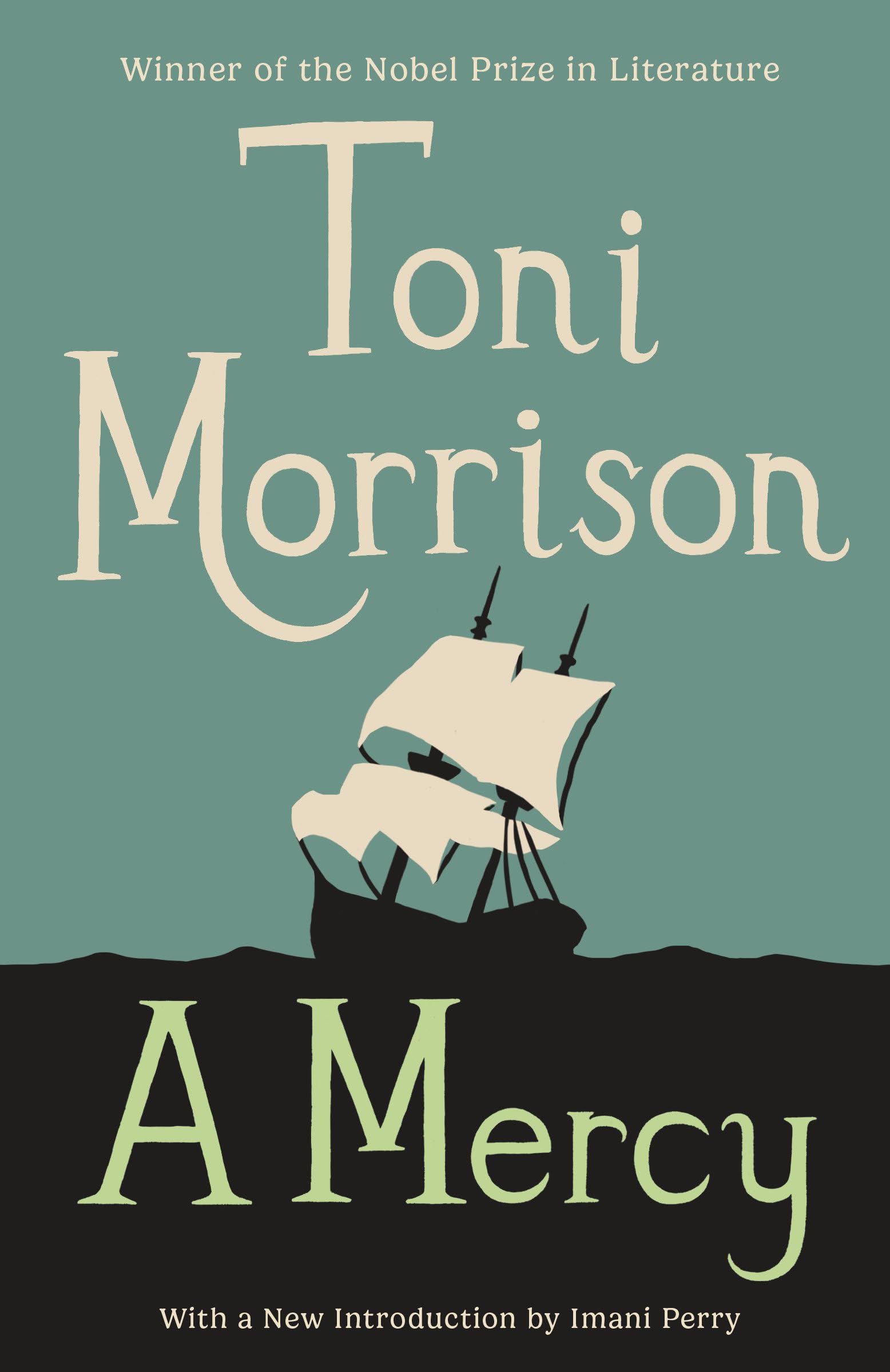
NATIONAL BESTSELLER • The acclaimed Nobel Prize winner reveals what lies beneath the surface of slavery. But at its heart, like Beloved , it is the story of a mother and a daughter—a mother who casts off her daughter in order to save her, and a daughter who may never exorcise that abandonment. One of the New York Times ’s 100 Best Books of the 21st Century “Spellbinding. . . . Dazzling. . . . [ A Mercy ] stands alongside Beloved as a unique triumph.” — The Washington Post Book World In the 1680s the slave trade in the Americas is still in its infancy. Jacob Vaark is an Anglo-Dutch trader and adventurer, with a small holding in the harsh North. Despite his distaste for dealing in “flesh,” he takes a small slave girl in part payment for a bad debt from a plantation owner in Catholic Maryland. This is Florens, who can read and write and might be useful on his farm. Rejected by her mother, Florens looks for love, first from Lina, an older servant woman at her new master's house, and later from the handsome blacksmith, an African, never enslaved, who comes riding into their lives. A NEW YORK TIMES BOOK REVIEW BEST BOOK OF THE YEAR “Spellbinding. . . . Dazzling. . . . [ A Mercy ] stands alongside Beloved as a unique triumph.” — The Washington Post Book World “ A Mercy conjures up the beautiful, untamed, lawless world that was America in the seventeenth-century with the same sort of lyrical, verdant prose that distinguished [ Beloved ]. . . . A heartbreaking account of lost innocence and fractured dreams. . . . One of Morrison's most haunting works yet.” —Michiko Kakutani, The New York Times “Luminous and complex. . . . Some of Morrison's best writing in years.” — Time “Magnificent . . . As with all Morrison’s finest work, A Mercy compellingly combines immediacy and obliquity. Its evocation of pioneer existence in America surrounds you with sensuous intensity. . . . An attack by a bear is described with thrilling power. . . . Idioms have potent directness, too. . . . Rich knowledgeability about 17th-century America is put to telling effect. Voices speak to you as if you were there. . . . The book keeps you vividly aware of the vital human individuality that racism’s crude categorizations are brutally trying to iron out. . . . A stark story of the evils of possessiveness and the perils of dispossession emerges slantwise. Hints, suspicions, secrets, ambivalences, scarcely acknowledged motives and barely noticeable nuances serve as signposts to enormities and desperations: around slavery’s large-scale uprootings, Morrison spotlights individual instances of loss (orphans and outcasts are, as often in her fiction, much in evidence; compensatory alliances they form are warmly portrayed). A Mercy is so enthralling that you’ll want to read it more than once. On each occasion, it further reveals itself as a masterpiece of rewarding complexity.” –Peter Kemp, The Sunday Times (London) “In [ A Mercy, ] a mother chooses to give her daughter to a stranger, the man who will ‘own’ her, in hopes that she’ll find a better life. It is this act from which the book derives its title, but it is, of course, an ambivalent gesture whose tragic resonance will be slowly unveiled. . . . Morrison here is seeking some deeper truth about what she once called ‘the presence of the unfree within the heart of the democratic experiment.’ Some regard this novel as a kind of prelude to Beloved, but the author has even more provocative ideas at play. . . . In writing about the horror of slavery, she finds a kind of ragged hope.” –Renée Graham, Boston Sunday Globe “[ A Mercy ] examines slavery through the prism of power, not race. Morrison achieves this by setting A Mercy in 1680s America, when slavery was a color-blind, equal-opportunity state of misery, not yet the rigid, peculiar institution it would become. . . . Morrison doesn’t write traditional novels so much as create a hypnotic state of poetic intoxication. You don’t read A Mercy, you fall into a miasma of language and symbolism. [It] offers an original vision of America in its primeval state, where freedom was a rare commodity.” –Deirdre Donahue, USA Today “Themes of slavery and grief, of women’s struggles to escape the bitterness of the captive world, are at the center of Morrison’s work. They also lie at the heart of her new novel, A Mercy, which looks to history [as in Beloved ]–in this case, the 1680s and 1690s–to explore the agonies of slavery among the settlers of the New World. Such a description makes Morrison’s novel sound far too pat, however; it slights the poetry and breadth of her work. Yes, A Mercy is about slavery, but in the most universal sense, meaning the limits we place on ourselves as well as the confinements we suffer at the hands of others. . . . [It is] a work of poetry and intelligence, and a continuation of what John Updike has called [Morrison’s] ‘noble and necessary fictional project of exposing the infamies of slavery
| Color | Teal/Turquoise Green |
| Gtin | 09780307276766 |
| Mpn | 9780307276766 |
| Age_group | ADULT |
| Condition | NEW |
| Gender | UNISEX |
| Product_category | Gl_book |
| Google_product_category | Media > Books |
| Product_type | Books > Subjects > Literature & Fiction > Genre Fiction > Coming Of Age |