

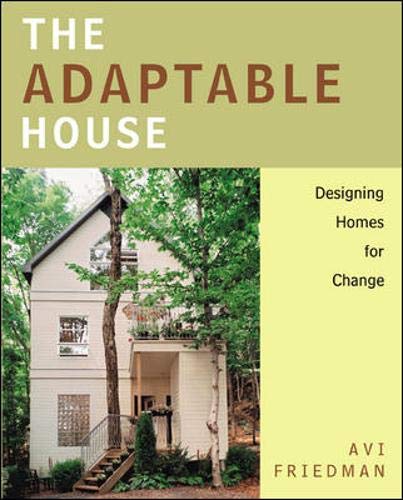
Author Avi Friedman believes that rather than being unchangeable, physical environments should be designed and constructed to easily adjust to the evolving lifestyle of their inhabitants. A home, he contends, should be structurally flexible enough to adapt to changes such as children "leaving the nest," elderly relatives moving in, or the need for home office space.. . Written by an internationally recognized flexible housing advocate, The Adaptable House provides specific design approaches and techniques that facilitate flexible design--both on the inside and outside--making it simple to alter a dwelling layout, demolish partitions or build new ones, upgrade heating systems, change the locations of stairs, etc.. . The book is divided into three logical sections: the first sets the stage for adaptability, the second outlines relevant principles, and the last shows their actual application. Packed with floor plans, drawings, photos, and charts to fully and clearly illustrate his suggestions, The Adaptable House includes detailed coverage of:. * Interior layouts and room configurations. * Exterior elements such as roofs and facades. * New building materials and methods. * Easy add-on and remodels. * Single-family and multiple dwelling housing. . The Adaptable House is a master blueprint for those interested in creating homes that can be quickly, easily, and inexpensively redesigned to meet the dynamic nature of the occupants' life. Excerpts from article written by Avi Friedman. . Adapting Mind-Sets to Nature . . The La Foret de Marie-Victorin project began when Jean-Marie Lavoie and Paul Brassard, retired architects from the Quebec City area purchased a 41-hectare (102-acre) plot of densely-forested land in a town called Saint-Nicolas. Proximity to the Saint Lawrence River with a view of the city in the far distance made the site a prime location for a residential development.. . When Lavoie and Brassard contemplated their approach to the site design and the type of homes they wished to build, they realized that they must apply unconventional thinking to their decisions. They recognized that common approaches to contemporary development--those that involve clearing the forest and building wide boulevards--would destroy the natural beauty of the site. The homes, they also decided, should not be sprawling suburban dwellings whose construction would mean extensive alteration of the landscape. They instead agreed that adaptability to the topography needed to play a pivotal role in both urban planning and unit design. In their search for a housing prototype that would satisfy these requirements, they became familiar with my work and invited me to collaborate with them in the design of both the community and the homes. A set goal was to promote sustainable living and create a community that contributed to such a mind-set.. . Sustainable Living . . The notion of sustainable development was introduced in the seventies as a result of recognition of the environmental harm that current development practices had caused. Authors like Schumacher in his 1973 book Small is Beautiful warned of actions that, if pursued further, could endanger the delicate balance between people and nature. Years later, this reflection led to the establishment of several international organizations that attempted to outline specific actions to remedy the situation. In their 1987 report, Our Common Future, the Brundland Commission defined sustainable development as "development that meets the present without compromising the ability of future generations to meet their own needs." A conceptual approach whereby every present action has to be taken while considering its future effect on the environment was put in place.. . When broken into sub-components, three main aspects were seen as influencing the functioning of a sustainable community. The first is society itself: the people who reside in the development, on their demographic make-up, and their lifestyles. The economic vitality of the development is also an essential aspect, since monetary failure will cause the enterprise to cease to exist. The final issue is the environment itself--with its many facets which include the built components and nature. Only when a balance is struck between these three elements, a balance that considers the future, is sustainable development possible.. . Since the turn of the twentieth century, and especially after World War II, bad development practices have begun to take their toll. There were many ramifications to such practices in which the environment was one of the main casualties. Forested landscape was cleared to make room for wide roads. Vast green spaces were covered with sod that needed large quantities of fresh water during dry summer months. The homes themselves swelled in size. North America consumed domestic space much like any other product. The design of homes became more intricate and complex, leading to the use of man
| Gtin | 09780071377461 |
| Mpn | 50-17051 |
| Age_group | ADULT |
| Condition | NEW |
| Gender | UNISEX |
| Product_category | Gl_book |
| Google_product_category | Media > Books |
| Product_type | Books > Subjects > Engineering & Transportation > Engineering > Reference > Architecture > Methods & Materials |