

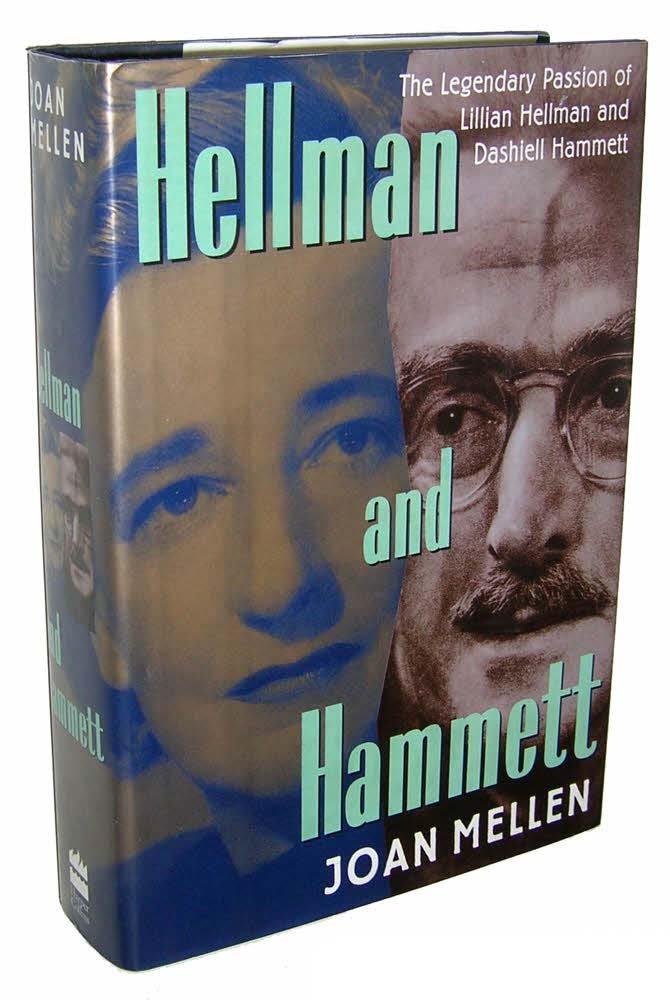
The first dual biography and love story of two powerful personalities, this book draws from previously untapped sources such as the Hellman-Hammett archives at the University of Texas, excerpts from Hellman's diary written as Hammett lay dying, and many more. $20,000 ad/promo. Despite past sentiment that writers Lillian Hellman and Dashiell Hammett should be celebrated--for their writing and societal escapades--Joan Mellen reveals that deceit and insecurity founded their relationship, and the only real loyalty they possessed was for Stalin. As unregenerate Stalinists, they publicly endorsed the verdicts in the Moscow purge trials and never recanted their oft-stated belief that the Soviet Union under Stalin was, "the ideal democratic state." While Hammett will be remembered along with Raymond Chandler for his detective fiction, Hellman's work, according to Mellen, was her attempt to be like him rather than to shape her own identity. Mellen, who has written biographies of Kay Boyle, Bobby Knight, and Marilyn Monroe, was able to use in her latest work material that was not available to previous biographers of Lillian Hellman and Dashiel Hammett. As a result, there will be surprises in store for readers of the romanticized versions of events chronicled in Hellman's memoirs (An Unfinished Woman, 1969; Pentimento, 1973) and works based on her writing (Julia, 1976) or written with her approval. Mellen delivers a searing view of two gifted and tousled writers and their turbulent relationship. Though the book is not a mudfest celebrity bio, it does vividly portray Hellman and Hammett as a couple of mating hellcats rather than the fiery, virtuous, intellectual lovers we've come to know from previous representations. Recommended for biography and literature collections.?Denise Johnson, Bradley Univ. Lib., Peoria, Ill. Copyright 1996 Reed Business Information, Inc. Hammett, lean, mean, and charming, was at the height of his glory when Hellman, brilliant, bold, and elegant, accosted him at a Hollywood nightclub in 1930, thus launching one of the world's most notorious literary love affairs. Mellen, author of the superb Kay Boyle (1994), writes with keen insight into writers' temperaments, oeuvres, and cultural milieus. Here, in the first dual biography of Hammett and Hellman, she presents the arresting, sometimes appalling facts of their lives with great dramatic flair and illuminating compassion. Hammett was addicted to alcohol and promiscuity when he and Hellman fell in love, habits he adamantly refused to break. Hellman, always trying to compensate for her lack of beauty, fought back by conducting numerous affairs of her own. Positive that her success as a dramatist depended on Hammett's literary acumen, Hellman condemned herself to 30 years of anguish. It's both sad and fascinating to watch the balance of power shift as Hammett drowns his muse and Hellman, writing for dear life, achieves fame and fortune. Mellen dispels the haze of myth that has surrounded these two powerful and controversial personalities, revealing the hard but unforgettable truths about their messy, very public lives and impossible but enduring love. Donna Seaman A complex literary relationship gets an intense treatment that, thanks to the delicious awfulness of its central characters, is worth reading--but with caution. Drawing on numerous interviews as well as published and unpublished documents, Mellen (Kay Boyley, 1994, etc.) follows her outrageous protagonists from their 1930 Hollywood meeting, when Hammett's writing career was trailing off and Hellman's had not yet begun, to the years after Hammett's death, when Hellman effectively rewrote their relationship in her memoirs. The result is a gossipy account of love, literary mentorship, drink, and betrayal. Mellen's comments occasionally seem more appropriate for after-dinner conversation than thoughtful biography; she casually notes, for instance, that ``like any woman pained by her appearance, [Hellman] took sexual rejection hard.'' Likewise, Mellen's handling of information bears watching. For example, discussing the 1951 lien filed against Hammett for not paying income taxes while serving in WW II, she quotes Hammett wondering if he has four months after his return to pay up; elsewhere, Mellen fudges this to say Hammett thought he had ``plenty of time,'' thereby skirting the question of why he didn't pay. Other snags look like simple carelessness, as when Mellen reports that Hellman frightened a five-year-old godchild by saying, ``When the plane goes down, I'll get you.'' What plane was Hellman referring to? The book offers no context for the quotation. Such handling of detail gives readers ample room to wonder if the ideas organizing Mellen's work (such as her sense that Hammett deliberately and consciously transferred his ``creative enterprise'' and even his ``identity'' to Hellman) would hold up under scrutiny. Impressive research, but the rough edges make one wish Hammett had b
| Gtin | 9780060183394 |
| Age_group | ADULT |
| Condition | NEW |
| Gender | UNISEX |
| Product_category | Gl_book |
| Google_product_category | Media > Books |
| Product_type | Books > Subjects > Biographies & Memoirs > Arts & Literature > Authors |