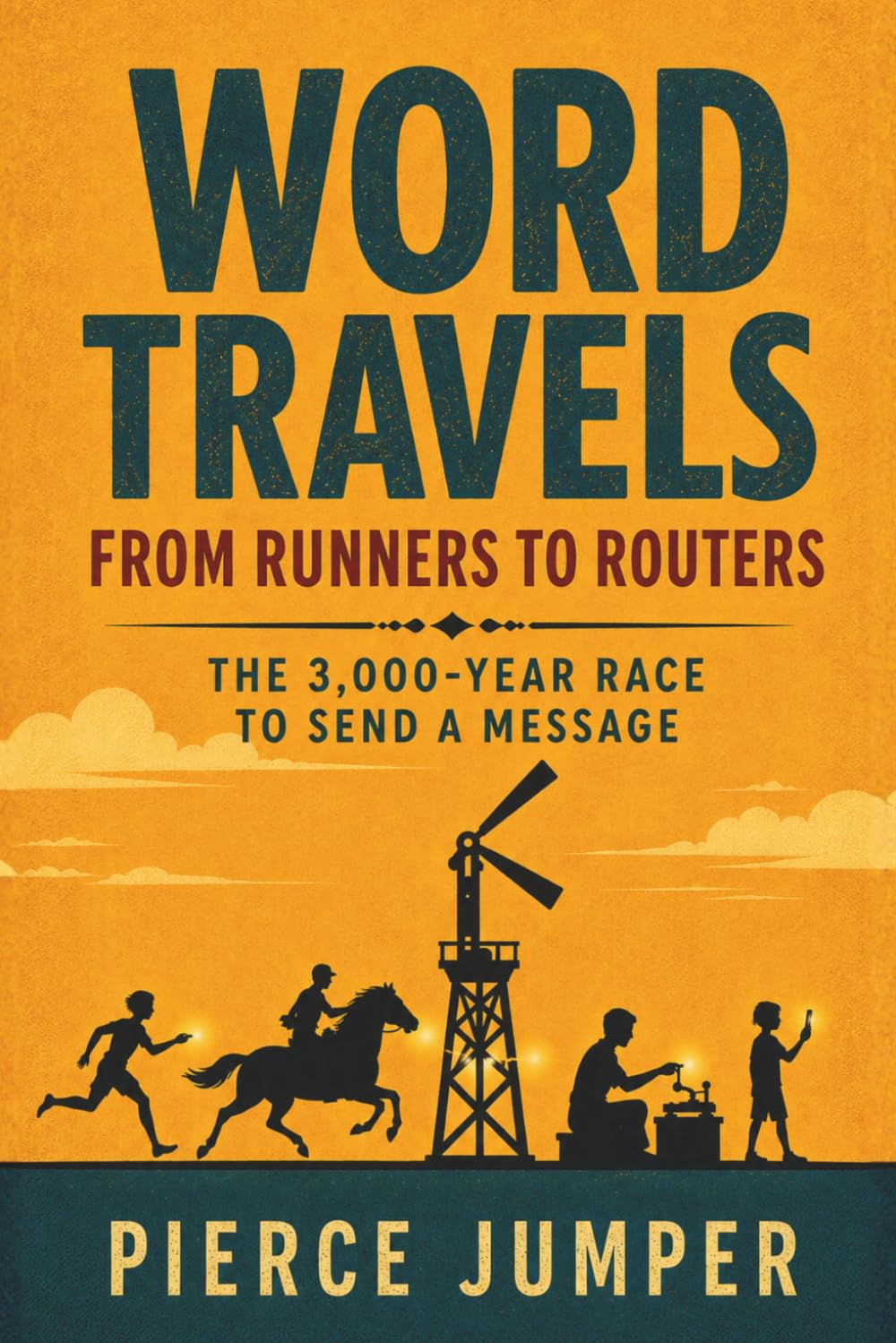
Eleven words. Five hundred miles. Go. In ancient Greece, that message takes eighteen days . Today it takes two hundredths of a second . Nobody made the message shorter. Nobody moved the two places closer together. So what actually changed? Word Travels is the story of how humans learned to send a message — from runners and signal fires to packet switching and the cables lying on the ocean floor right now. It's a history full of people who looked at the fastest thing on earth and thought that's too slow. True stories that sound made up A French engineer built a working network out of wooden arms and telescopes — and ran it for fifty years before electricity - Two bankers hacked that network in 1834, got caught, and walked free because no law existed for a crime nobody had imagined - A city under siege flew pigeons out by hot air balloon so they could fly messages back in - The first message ever sent on the internet was supposed to say LOGIN. It got as far as LO - A programmer invented email in 1971 on his own time, and told a colleague not to mention it because it wasn't his assignment Twelve chapters. Twelve experiments. This isn't a book you only read. Readers build a semaphore signal tower out of cardboard and send messages across the yard. They prove salt water can steal an electrical signal. They cut a message into numbered pieces and route them through the house by different hallways — discovering, hands-on, the exact trick a phone uses every time someone hits send. They read the hidden trail inside a real email and map every machine it passed through. Every experiment produces a number, and readers keep them all. In the final chapter, they measure how fast a message crosses an ocean and compare it to the very first number they wrote down. Same stopwatch. Three thousand years apart. Written for curious readers ages 9–12 Clear, factual, and respectful of young readers as capable thinkers. Where a famous story turns out to be legend, this book says so — and explains how historians know. Includes a full materials list, Morse code and semaphore charts, timeline, glossary, source notes, and a guide to museums where readers can see the real machines. Batteries only. No household current in any activity.