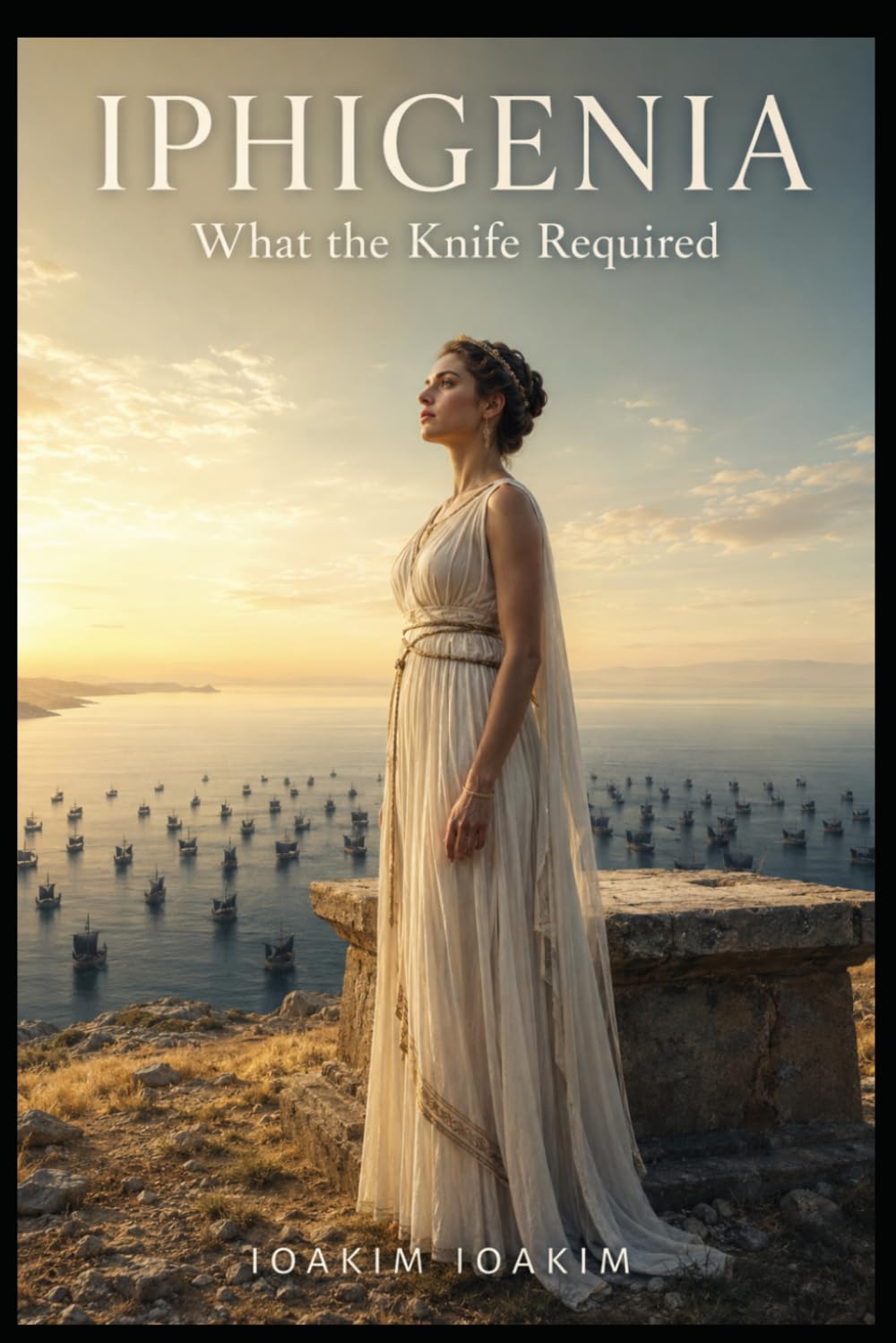
She loved her father. She is going to begin with this, before the altar, before the lie, before the wind that would not come until it was bought with the price he agreed to pay. She loved him. The love was real. And she is going to tell you what happened anyway, without flinching, because she has had years at Tauris to learn how to look at a thing directly. Iphigenia is fifteen when she is brought to Aulis. She is told she is going to be married — to Achilles, the best of the Greeks, at the camp where the fleet is gathered to sail for Troy. She is told to come quickly. She comes. She does not know that the Oracle has spoken, that her father has made a calculation, that ten thousand men are waiting for a wind that will only come if the king's daughter is offered at the altar. She finds out from Achilles himself, who is furious that his name was used without consent, who tells her the truth in the flat honest way he tells everything. The ground falls away. She goes to her mother, who tries to stop it and cannot. She goes to her father, alone, and asks him the question directly: how does a man who loves his daughter bring her to an altar. He answers her. And then she walks there herself. IPHIGENIA: WHAT THE KNIFE REQUIRED is the story of what happens before the altar and what happens after — the years at Tauris, the practice of looking at an impossible thing until you can hold it, and the return that finally comes when her brother arrives on the shore as a stranger. It is a novel about love and betrayal within the same family, about what it costs to understand a person completely, and about the specific survival of someone who refused to be only the price that was paid. She was a girl on an altar. She tells the story herself.