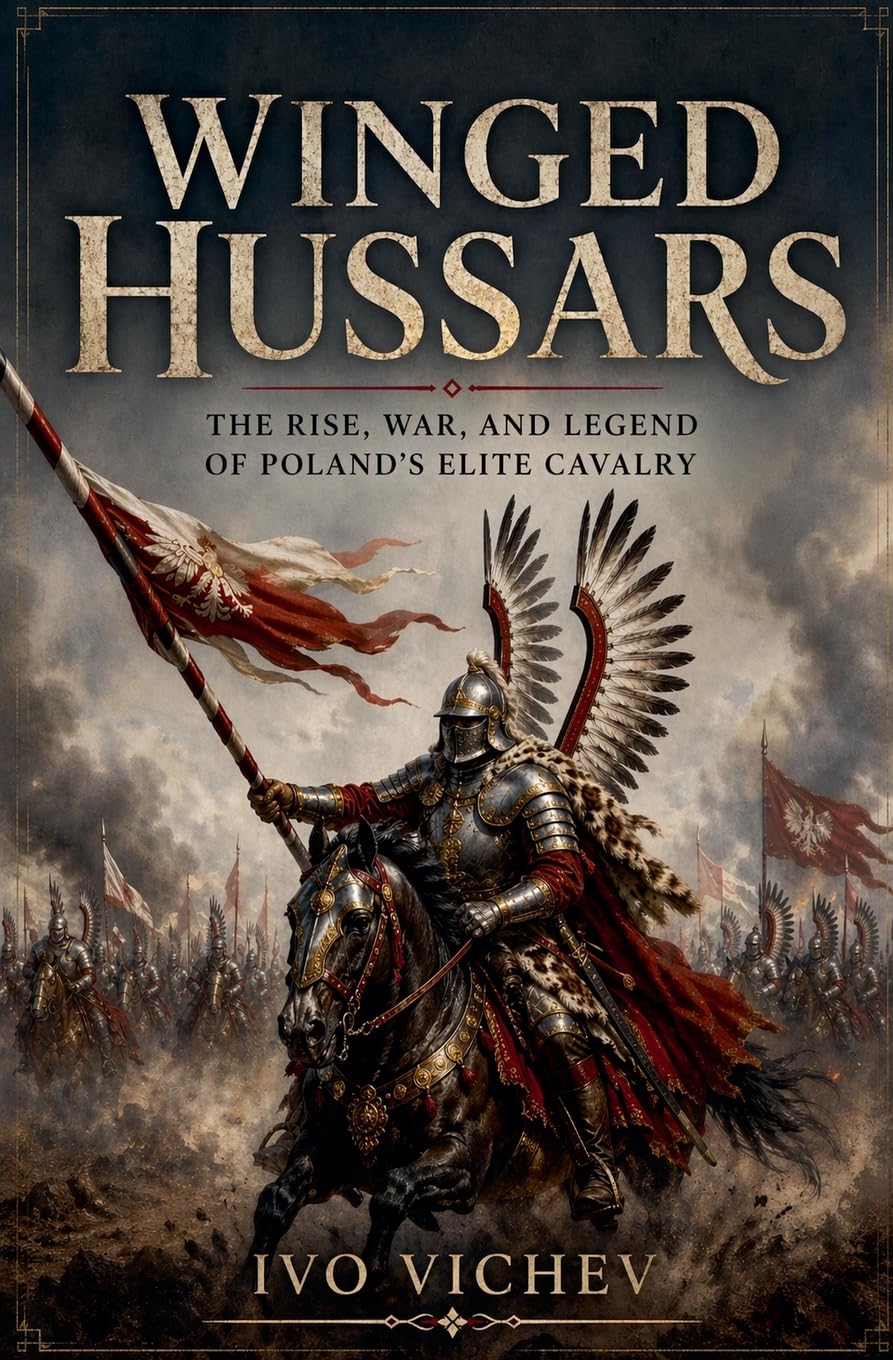
Winged Hussars: The Rise, War, and Legend of Poland's Elite Cavalry They hit the battlefield with feathered wings, lowered lances, and enough force to shatter entire armies. The Polish Winged Hussars weren't fantasy. They were real - and the real story hits harder than any myth ever could. Ivo Vichev strips the Hussars down to what they actually were: not legend, not symbol, not some romanticized cavalry charge frozen in a painting. A military institution. Built from warhorses bred for shock combat, hollow lances engineered to splinter on impact, ruinously expensive hussar armor, noble obligation, battlefield discipline, and a Polish-Lithuanian Commonwealth that depended on elite heavy cavalry while chronically struggling to fund it. This book traces the Winged Hussars from their Balkan and Hungarian cavalry origins through their transformation inside the Commonwealth's military system. The reforms of Stefan Batory. The devastating charge at Kircholm 1605. The impossible victory at Kluszyn 1610. The sieges and slaughter at Chocim, Berestechko, and the Battle of Vienna 1683 - the charge that broke the Ottoman siege and cemented the Hussars in European military history forever. But Vichev doesn't sell you invincibility. The Hussars had tactical limits. They were a specialized shock cavalry arm - devastating under the right conditions, vulnerable when warfare evolved past them. Their power came from preparation: the companion system, the retinue structure, the trained formation riding knee-to-knee, and the brutal economics of campaign service in early modern Poland. This is military history that gives you the thunder of the charge and the machinery behind it. The men under the wings. The horses that carried them. The Commonwealth that produced them. The battles that made them feared across Europe. The legend that outlived them all. Polish military history, early modern European warfare, cavalry tactics and history, the Polish-Lithuanian Commonwealth, hussar armor and equipment, and the Battle of Vienna 1683. If you want the real Winged Hussars - not the fantasy, not the meme, not the video game version - this is the book. I was born in Varna, Bulgaria, on the edge of the Black Sea - a place where history is never really "past". Growing up between old empires and new borders, I was surrounded by stories of wars, occupations, disappearances and sudden changes of flag. Later I moved to Warsaw, Poland, where I studied history and public relations at the Polish Academy of Sciences (PAN). Warsaw is a city built on ruins and memories, and it forced me to ask one question over and over again: Why is so much of our most important history told in the most boring way possible? From dry facts to living stories Like every history student, I spent endless hours buried in heavy academic books - dates, treaties, footnotes stacked on footnotes. I respected the work, but I often felt like the life had been drained out of the events themselves. That changed when I discovered Ryszard Kapuściński. His books had that rare tone I'd been searching for: history and politics told through people, scenes and atmosphere. It was factual, but it breathed. From that moment I knew what I wanted to do: take serious history and tell it with the clarity and tension of a documentary - so future generations don't have to suffer through dead, lifeless books to understand the past. What I write about My books focus on the places where power is most visible - and most hidden: Wars and battles - Espionage and cyber conflict - Country histories Some books are big, sweeping national histories. Others zoom in on a single battle, uprising or covert operation. All of them try to answer the same question: What really happened here, and what does it mean for the people who had to live through it? How I tell history If you read my books, you can expect narrative, scene-by-scene storytelling - not just lists of dates. Serious research from archives, memoirs, official reports and investigative journalism. Clear explanations of complex events like cyberattacks and proxy wars. And a refusal to simplify messy, uncomfortable truths. I don't write official history. I don't write propaganda. I write stories that are honest, human and readable - the kind of books I was always looking for as a student and rarely found. If you care about how we got from trenches and partitions to cyberwar and drone strikes - and you don't want to fall asleep over another textbook - I wrote these books for you.