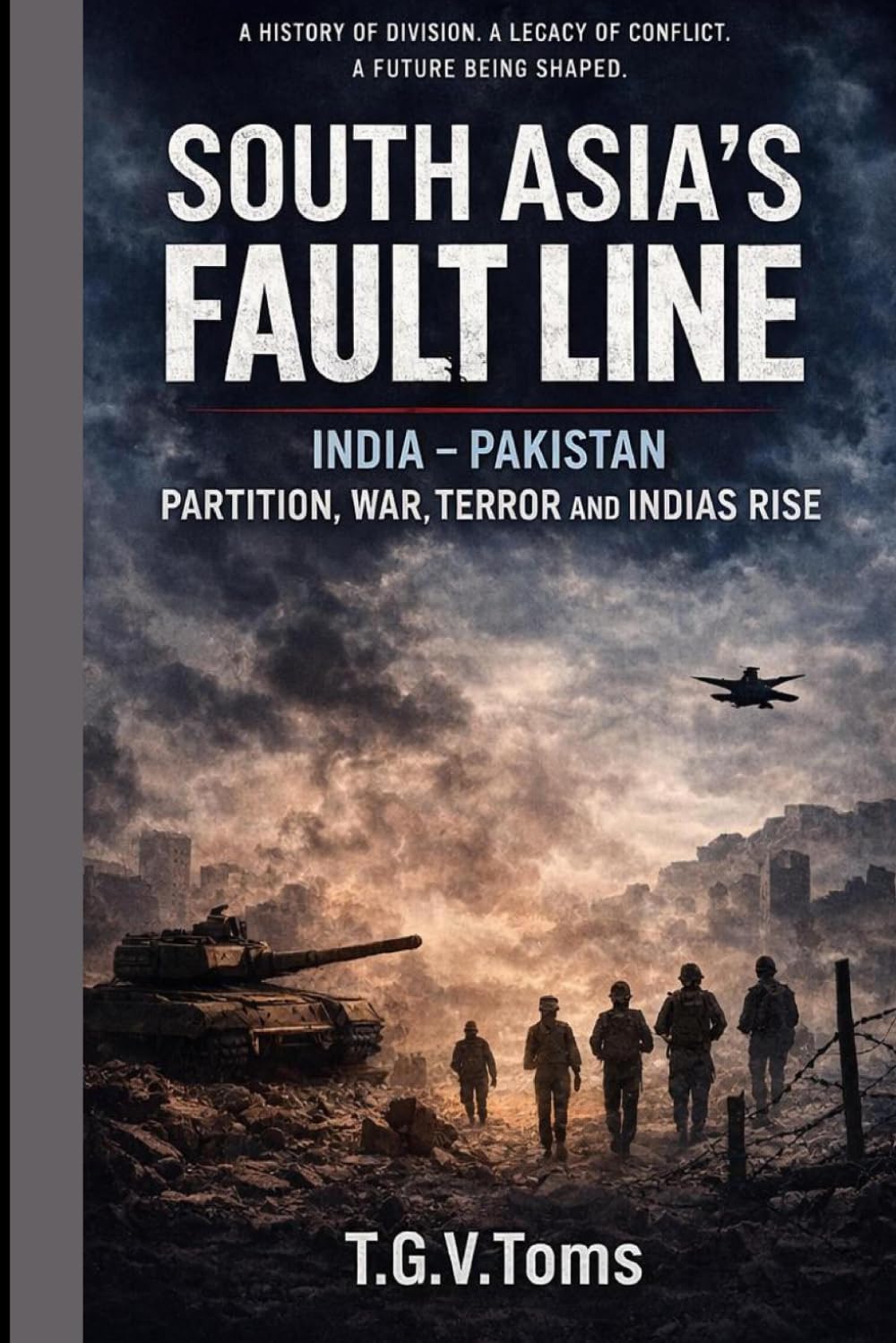
South Asia’s Fault Line: India-Pakistan Partition, War, Terror, and India’s Rise is a deeply engaging journey into one of the most complex and enduring rivalries of the modern world. It begins not just with Partition in 1947, but with the deeper currents that made division possible—colonial strategies, political calculations, and the gradual transformation of identity into a tool of power. When the British left, they did not leave behind peace. They left behind a fractured land, unresolved questions, and a future already shadowed by conflict. What followed was not a single war, but a chain of confrontations—military, political, and psychological—that would define the region for decades to come. This book traces that journey with clarity and depth. From the first war over Kashmir to the high-altitude conflict of Kargil, from the birth of Bangladesh to the emergence of nuclear deterrence, the narrative moves across time to reveal how each event was not isolated, but connected to a larger pattern. A pattern where every decision, every miscalculation, and every strategic move shaped the next phase of the conflict. But the battlefield was never limited to soldiers and borders. A quieter, more persistent struggle emerged alongside open war—a shadow war fought through intelligence networks, proxy actors, and calculated disruption. Terror attacks shook cities, challenged institutions, and forced a nation to respond not only with strength, but with resilience. The conflict expanded beyond territory into perception, narrative, and global opinion, where the story itself became a weapon. At the same time, the region was not standing still. Bangladesh, born out of war, began charting its own path. Afghanistan became a stage for competing strategic visions. Myanmar emerged as part of a broader eastern equation. South Asia was no longer just about two nations facing each other across a border—it became a dynamic and evolving geopolitical space shaped by multiple actors and shifting realities. Amid all this, India’s story took a different direction. Facing wars, external pressure, internal challenges, and persistent threats, India was forced to adapt, respond, and grow. What emerges in these pages is not just a history of conflict, but a story of endurance and transformation. A nation navigating instability while building strength—military, economic, and strategic—until it begins to redefine its place in the region and beyond. This book does not treat events as disconnected episodes. It connects them into a continuous narrative, where the past is never truly past, and where the present carries the weight of decisions made decades earlier. It looks at leadership, policy, strategy, and consequence with a clear, grounded perspective, avoiding simplification while remaining accessible to the reader. More importantly, it does not lose sight of the human dimension. Behind every war, every decision, and every strategic shift are lives shaped by forces far beyond their control. The cost of conflict is not abstract—it is real, and it echoes across generations. Written in a compelling and reader-friendly style, this is not a dry academic account, nor is it a superficial retelling of familiar events. It is a carefully woven narrative that brings together history, geopolitics, and strategy into a story that is as informative as it is engaging. This is a book about how South Asia was divided, how conflict was sustained, and how power is evolving in the region today. It is about the visible battles and the invisible ones, the decisions that shaped nations, and the consequences that continue to unfold. Above all, it is about understanding. Understanding how a region came to be defined by fault lines. Understanding how those fault lines continue to influence the world. And understanding how, in the midst of pressure and uncertainty, a nation rises.