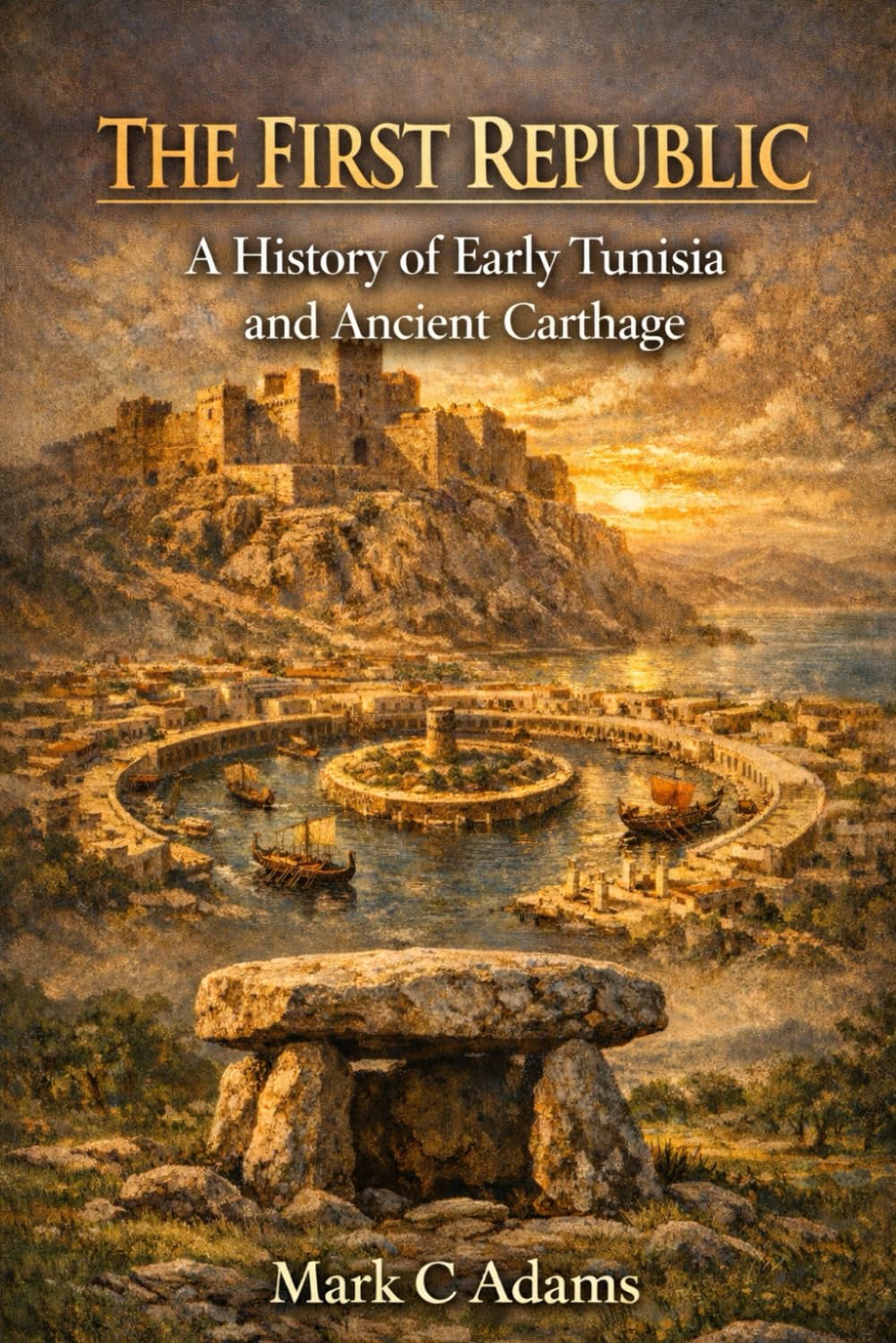
The history of Tunisia spans thousands of years and includes an immense variety of cultures, conquests, environments, political, and religious changes. The First Republic delves into the land that would become Tunisia and how it occupies a pivotal place in the history of the Mediterranean and North Africa. Situated between the eastern and western basins of the sea, and bounded by the Sahara to the south, this region has long served as a crossroads of peoples, ideas, and empires. From the earliest human communities that adapted to its varied landscapes, through the rise and fall of Phoenician, Roman, Vandal, and Byzantine power, and culminating in the first decades of the Arab-Islamic expansion, the history of early Tunisia is one of continuity as much as transformation. Long before written records, prehistoric societies shaped the foundations of life in the region. Archaeological evidence reveals complex interactions between environment, technology, and social organization, particularly as climatic shifts altered patterns of settlement and subsistence. These early communities laid the groundwork for later cultural developments, establishing networks of exchange that linked the interior of North Africa with the wider Mediterranean world. The arrival of Phoenician traders in the late second millennium BCE marked a decisive turning point. With the founding of Carthage, Tunisia became the center of one of the most powerful states of the ancient world. Carthage’s maritime empire, commercial networks, and distinctive political institutions not only challenged Greek and Roman rivals but also reshaped the social and economic landscape of North Africa. Even after its destruction in 146 BCE, Carthaginian traditions continued to influence the region under new forms of rule. Roman domination ushered in another profound transformation. As the province of Africa Proconsularis, Tunisia emerged as one of the empire’s most prosperous territories, renowned for its agricultural output, urban development, and intellectual life. Cities flourished, monumental architecture reshaped the countryside, and Christianity took deep root, producing influential thinkers whose works resonated across the Roman world. Yet Roman authority was neither monolithic nor uncontested; it coexisted with local identities and was periodically challenged by rebellion and external invasion. The later centuries of imperial rule, under the Vandals and subsequently the Byzantines, reveal a region marked by both resilience and fragmentation. Political instability, religious conflict, and shifting economic conditions altered the balance between city and countryside, while North Africa’s strategic importance continued to draw imperial attention. By the early seventh century, Tunisia stood at the intersection of an aging Mediterranean order and emerging forces from Arabia. The year 647 CE, traditionally associated with the first major Arab-Muslim incursion into North Africa, serves as a natural point of transition. It signals not an abrupt end to the past, but the beginning of a new historical phase in which earlier structures, populations, and traditions would be reconfigured within an Islamic framework. This First Republic traces the history of early Tunisia from its prehistoric roots to this critical moment of change. Drawing on archaeological findings, classical sources, and modern scholarship, it seeks to situate Tunisia within the broader histories of the Mediterranean and Africa, while also emphasizing the distinctive trajectories that shaped its development. By examining long-term patterns alongside moments of rupture, this study aims to illuminate how Tunisia’s early past forged enduring foundations for the societies that followed.