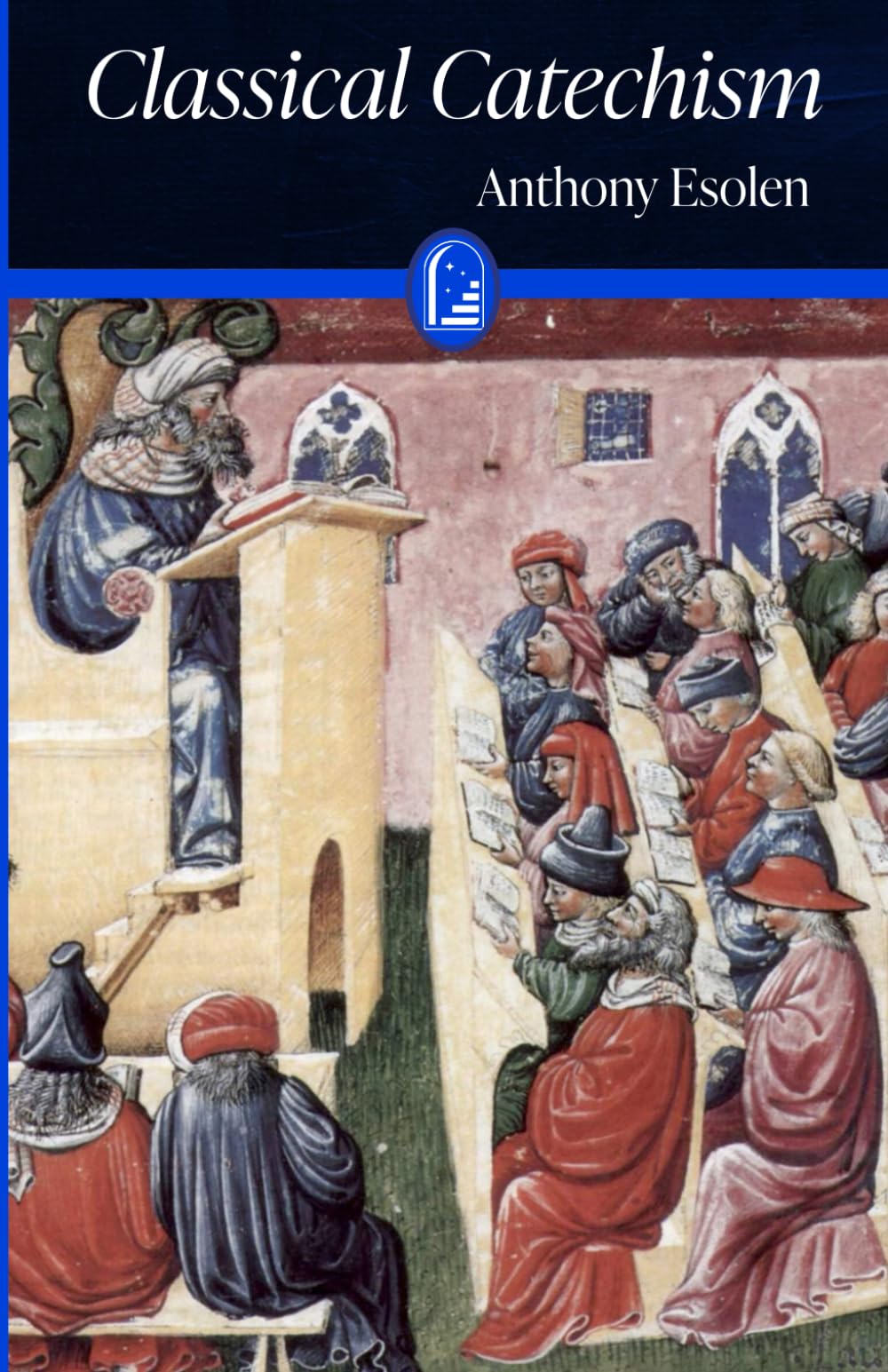
Classical education is grounded in the Great Books of the Western canon, is oriented towards truth, beauty, and goodness, and has as its goal the flourishing and happiness of students, teachers, and parents alike. Classical education was the standard course of study up until the twentieth century when the timeless wisdom of the ancients disappeared in favor of new, progressive, modern methods of educating students. Such attempts meant that multiple generations of students, students who are now adults, missed out on the values and virtues of classical education and the wondrous treasures of our intellectual inheritance. Written by Anthony Esolen, this Classical Catechism is meant to help bridge that gap, communicating what is good, true, and beautiful in a series of questions and answers. Dr. Anthony Esolen received his A.B. in English Literature from Princeton University and his M.A. and Ph.D. in Renaissance English Literature from the University of North Carolina at Chapel Hill. Dr. Esolen has been a professor of literature and humanities for 35 years and is the author or translator of more than 30 books, which include a range of English translations, analyses of culture, literary and Biblical criticisms, meditations on modern education, meditations on the Christian life, and original poetry. Dr. Esolen serves as a Distinguished Professor of Humanities at Thales College. Editorial Reviews "The book is itself difficult to summarize despite its small size. It is an introduction to the pedagogical life of a classical school. It is a philosophical argument for a particular approach to being a classical teacher. It is a work of cumulative experiences which manifest in teacherly wisdom. And it is a treatise aimed at critiquing the Modern Industrial Model of Education which has characterized the last several decades of American schooling. It is each of those things and more. The ability to say so much in such a small space is indeed itself a testimony to the rhetorical skills which result from being educated into the Classical Tradition, giving a weight to Esolen’s argument that would not be accomplished in a 600-page tome littered with footnotes and lengthy digressions. "If classical teachers believe that truth, beauty, and goodness can indeed change the world, then the sort of student (and teacher and school) described by Esolen is a net gain for this world. And his Classical Catechism serves as a helpful tool in building the necessary common language that can only strengthen what is already being done. It is my hope that more people who are involved with classical schools will take up Esolen’s book and consider it. For there is much work still to be done." Sean Hadley, the University Bookman. May 3, 2026 https://kirkcenter.org/reviews/talking-classical-education/