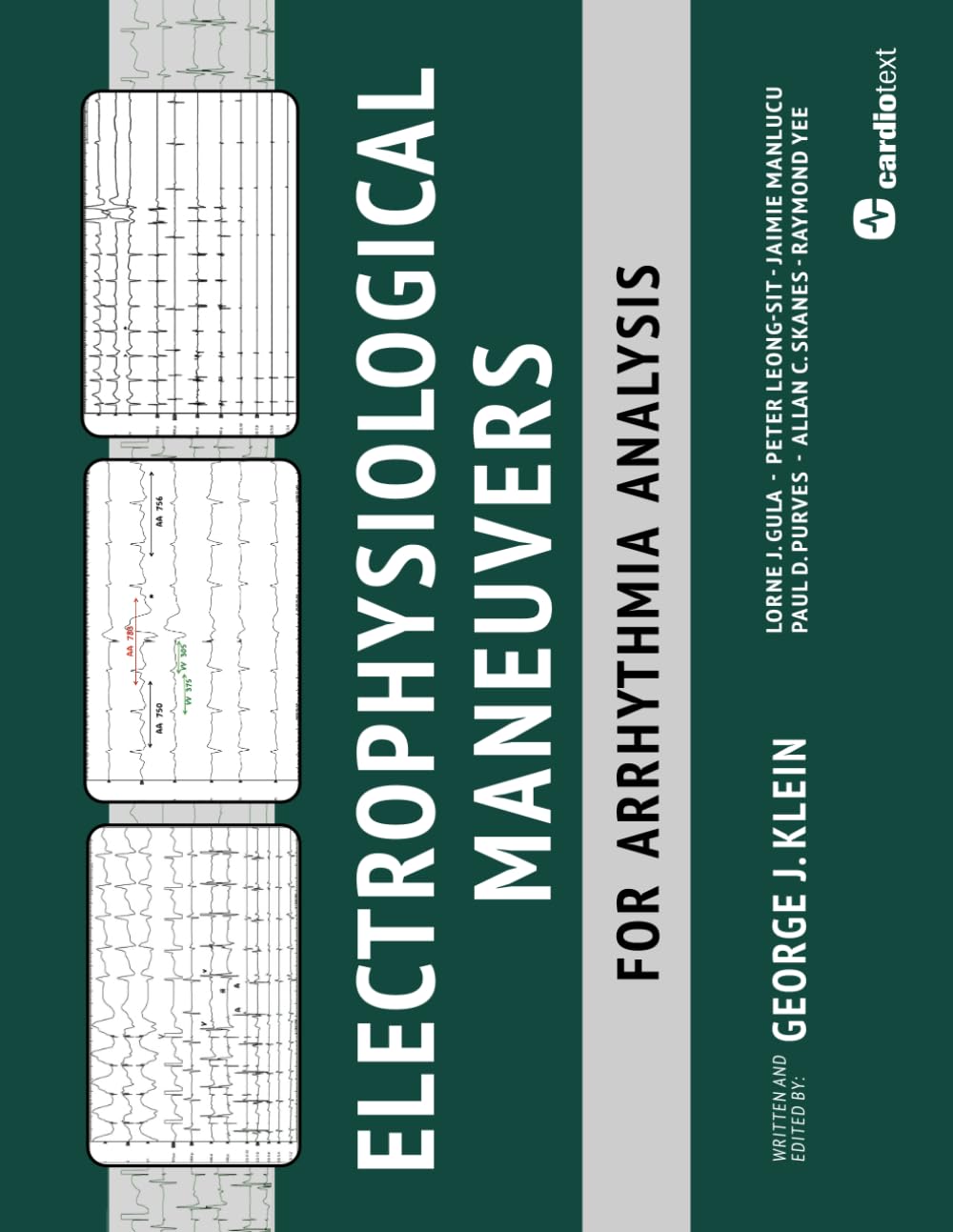
From senior electrophysiologist and world-class educator George Klein, a fully illustrated guide with over 100 intracardiac tracings and figures that allow the physician to approach electrophysiologic problems effectively and systematically. - The book is especially focused on electrophysiological maneuvers and provides a clear and understandable guide to their proper selection and interpretation using abundant clinical examples. - Defines the integral role for "traditional" electrogram (EGM) analysis in order to understand the mechanism of a tachycardia. It goes without saying that a correct arrhythmia diagnosis is a prerequisite to catheter ablation regardless of the presence of sophisticated mapping and imaging technologies. Electrophysiological maneuvers are fundamental to this process, and proper selection and interpretation of maneuvers constitute a core skill of the electrophysiologist. In this volume, we make the case that most maneuvers are fundamentally similar in principle and can be understood by appreciating a few basic physiological and anatomical principles. The art lies not in a comprehensive knowledge by rote of every maneuver or its application, but rather a systematic approach using common principles. We illustrate this by showing abundant examples and emphasizing the "game plan," including checklists that can be applied to virtually any maneuver. —George J. Klein In my opinion, this book should be on the shelf of every electrophysiologist trainee as well as every clinical cardiac electrophysiologist. It is a classic, like its editor. Dr. Klein deserves high praise for organizing his and his colleagues clinical experiences and thought processes into a concise, practical text that should be part of all training programs in electrophysiology. --From the foreword by Mark E. Josephson, MD This book comprehensively discusses the principles behind electrophysiology studies. The importance of understanding cardiac anatomy, the physiology behind the maneuvers, the study of arrhythmias, and the benefits as well as the shortcomings of specific maneuvers are well elucidated. -- --Doody Review by Saima Karim D.O. (Ochsner Clinic Foundation) George J. Klein, MD, FRCP(C); Professor of Medicine, Division of Cardiology, University of Western Ontario, London, Ontario, Canada Lorne J. Gula, MD, FRCP(C); Associate Professor of Medicine, Division of Cardiology, University of Western Ontario, London, Ontario, Canada Peter Leong-Sit, MD, FRCP(C); Assistant Professor of Medicine, Division of Cardiology, University of Western Ontario, London, Ontario, Canada Jaimie Manlucu, MD, FRCP(C); Division of Cardiology, University of Western Ontario, London, Ontario, Canada Allan C. Skanes, MD, FRCP(C); Associate Professor of Medicine, Division of Cardiology, University of Western Ontario, London, Ontario, Canada Raymond Yee, MD, FRCP(C); Professor of Medicine, Director, Arrhythmia Service, Division of Cardiology, University of Western Ontario, London, Ontario, Canada Paul D. Purves, BSc, RCVT, CEPS; Senior Electrophysiology Technologist , Cardiac Investigation Unit, London Health Sciences Centre, London, Ontario, Canada