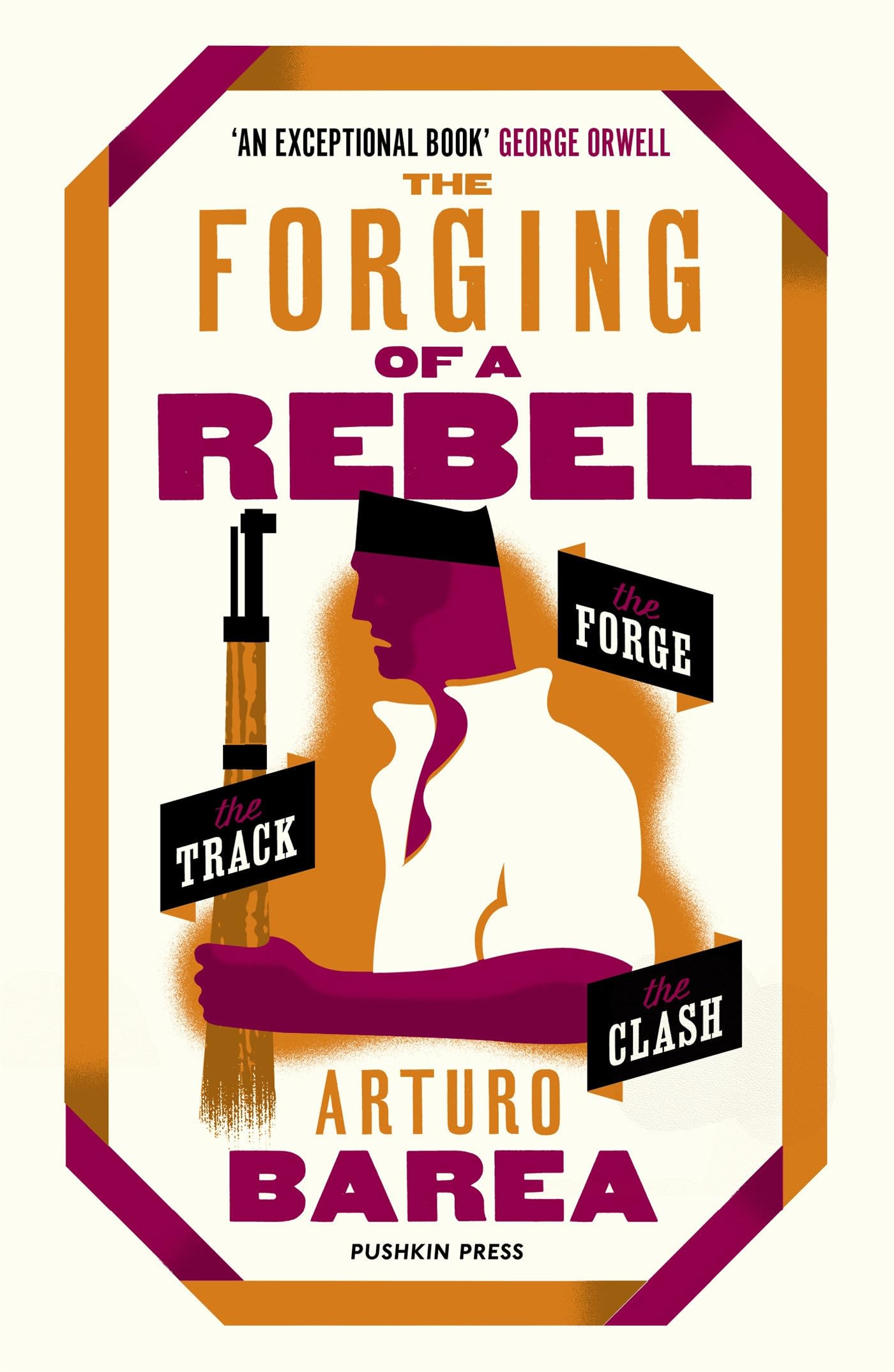
This astonishing autobiographical trilogy—hailed by George Orwell and Gabriel García Márquez—is “the most definitive and personal account of Spain’s history during . . . the 20th century” ( Guardian ). The Forging of a Rebel is an unsurpassed account of Spanish history and society from early in the twentieth century through the cataclysmic events of the Spanish Civil War. Arturo Barea’s masterpiece charts the author's coming-of-age in a bruised and starkly unequal Spain. These three volumes recount in lively detail Barea's daily experience of his country as it pitched toward disaster: we are taken from his youthful play and rebellion on the streets of Madrid, to his apprenticeship in the business world and to the horrors he witnessed as part of the Spanish army in Morocco during the Rif War. The trilogy culminates in an indelible portrait of the Republican fight against Fascist forces in which the Madrid of Barea's childhood becomes a shell and bullet-strewn warzone. Combining historical sweep and authority with poignant characterization and novelistic detail, The Forging of a Rebel is a towering literary and historical achievement. “This is an exceptional book.” — George Orwell, author of Animal Farm and 1984 “One of the great autobiographies of the twentieth century.” — New Republic “One of the most significant Spanish prose works of [the 20th] century . . . Moving and dramatic.” — New York Review of Books “Perhaps the most definitive and personal account of [Spain's] history during the first four decades of the 20th century.” — Guardian “As essential to an understanding of twentieth-century Spain as the reading of Tolstoy is indispensable to the comprehension of nineteenth-century Russia.” — Daily Telegraph This is an exceptional book. --George Orwell One of the best novels written in Spanish. --Gabriel García Márquez Arturo Barea (1897-1957) was born in Badajoz and raised and educated in Madrid. For most of the Spanish Civil War, he acted as head of the Foreign Press and Censorship Bureau of the Republican Government in Madrid and was also the radio broadcaster who spoke as the 'Unknown Voice of Madrid'. Eventually forced out of Spain, he sought temporary asylum in France before crossing to England just before the outbreak of World War II. He and his wife Ilsa settled in Eaton Hastings near Faringdon in Berkshire. From 1940 until 1957 he transmitted a weekly broadcast for Spanish Radio to South America. He published novels and short stories as well as books of criticism, and his great autobiographical trilogy The Forging of a Rebel first appeared in English between 1941 and 1946. Translator Ilsa Barea (1902-1973) was born and raised in Vienna, where she studied politics at Vienna University. In the 1930s she emigrated to Czechoslovakia for political reasons, before travelling to Spain in support of the Republican side early in the Civil War. She translated more than twenty books into English and lectured and broadcast in several languages. She died in Vienna while working on her autobiography. The Forging of a Rebel The Track, The Clash, The Forge By Arturo Barea, Ilsa Barea Pushkin Press Copyright © 2018 Pushkin Press All rights reserved. ISBN: 978-1-78227-494-0 Contents Introduction, 7, THE FORGE, 15, THE TRACK, 243, THE CLASH, 443, CHAPTER 1 RIVER AND ATTIC The wind blew into the two hundred pairs of breeches and filled them. To me they looked like fat men without a head, swinging from the clothes-lines of the drying-yard. We boys ran along the rows of white trousers and slapped their bulging seats. Señora Encarna was furious. She chased us with the wooden beater she used to pound the dirty grease out of her washing. We took refuge in the maze of streets and squares formed by four hundred damp sheets. Sometimes she caught one of us; then the others would begin to throw mud pellets at the breeches. They left stains as though somebody had dirtied his pants, and we imagined the thrashing some people would get for behaving like pigs. In the evening, when the breeches had dried, we helped to count them in tens. All the children of the washerwomen went with Señora Encarna up to the top story of the washhouse. It was a big loft with a roof like a V turned upside down. Señora Encarna could stand upright in the middle, but her top-knot nearly touched the big beam. We would stand at the sides and bang our heads against the sloping roof. Señora Encarna had in front of her the heaps of breeches, sheets, pants, and shirts. The pillow-cases were apart. Everything had its number. Señora Encarna sang it out and threw the piece to the boy in charge of the set of ten to which it belonged. Each of us looked after two or three groups, the "twenties," or the "thirties," or the "sixties," and had to drop each piece on the right heap. Last of all we stuffed into each pillow-case, as into a sack, one pair of breeches, t