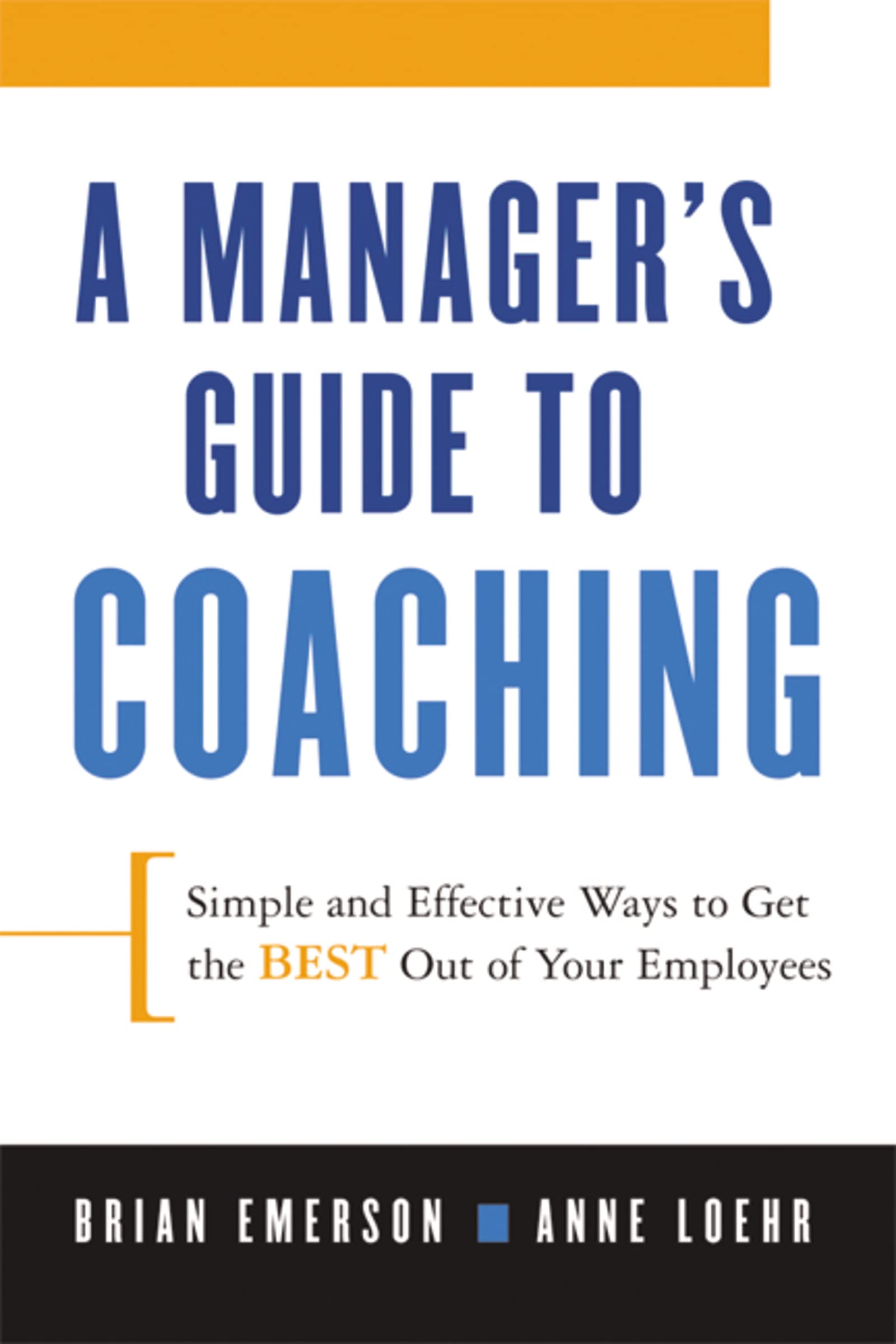
This is an invaluable tool that will help all leaders coach employees, colleagues, and themselves to excellence. To stay on top, companies need to do more than just survive, they need to grow. Thus, their employees need to develop and improve their skills at the same pace. Brian Emerson and Ann Loehr have spent years showing some of the country's top companies how to develop their most promising employees. In this helpful manual, they guide managers through every step of the coaching process, from problem solving to developing accountability. In A Manager's Guide to Coaching , you will discover: the top 10 tips every manager should know before he starts to coach - how to handle difficult conversations, conflicting priorities, and problem team members - how to hold follow-up meetings after goals and priorities have been set - sample questions they can adapt to various situations - examples of common problems and how they can use coaching to address them. More than ever, managers are being encouraged to improve employee performance through effective coaching, but many lack the time or knowledge it takes to do so. A Manager's Guide to Coaching teaches you how to coach your team effectively and successfully. Selected by Ready to Manage as one of the Top 20 Best Books on Coaching and Mentoring for 2012 To stay on top, you need to do more than just tread water—you need to grow. And that means that you need to progressively develop and improve your skills. As a manager, you may find yourself being encouraged to constantly improve employee performance through effective coaching, but you may not have the time—or the knowledge—to do it successfully. Brian Emerson and Anne Loehr have spent years showing some of the country’s top companies how to develop their most promising employees. This concise guide for busy managers gives you the tools you need to coach your people, and yourself, through any work situation. A Managers Guide to Coaching takes you through the entire coaching process from discovery, through clarifying wants, problem solving, defining action, and developing accountability. It provides specific, powerful questions to ask when coaching and motivating employees to peak performance, as well as sample conversations, responses, and different ways you can follow up. With compassion and honesty, the authors offer invaluable advice on: the top 10 tips every manager should know before you start to coach • how to handle difficult conversations, conflicting priorities, and problem team members • how to hold follow-up meetings after goals and priorities have been set • sample questions you can adapt to various situations • examples of common problems and how you can use coaching to address them. Clear, practical and straightforward, this is the secret weapon that will help you take your employees from good to exceptional. Brian Emerson and Anne Loehr are certified executive coaches and cofounders of Safaris for the Soul, leadership development retreats in Kenya, Patagonia, and Iceland. Anne Loehr specializes in the hospitality industry has worked with leaders at The Away Network, The Nature Conservancy, and Carlson Destination Marketing Services. Brian Emerson has advised clients such as PBS, the Howard Hughes Medical Institute, and the Natural Resources Defense Council on leadership development and effectiveness. They live in the Washington, D.C. area. Anne Loehr (Washington, D.C.) are certified executive coaches and cofounders of Safaris for the Soul, leadership development retreats in Kenya, Patagonia, and Iceland. Brian Emerson is a certified executive coach and cofounder of Safaris for the Soul, leadership development retreats in Kenya, Patagonia, and Iceland. CHAPTER 1 Getting the Best from Employees If you’re not growing, you’re dying. It’s a basic rule of life here on earth and in the business world today. It’s what drives most of us to be better at what we do and who we are. It’s the desire to “be more.” Because of this desire, the term “coaching” has caught the attention of both the personal-growth and business worlds, creating a multibillion-dollar-a-year industry and a situation in which everyone wants a coach. More than ever, employees are asking for developmental opportunities and managers are being told they need to “coach” their employees on a regular basis. We’ve even worked with managers who say they’ve been told to “stop managing and start coaching.” This all sounds great in theory—managers coaching employees to grow and be more effective—but there’s one problem. Although many people agree that having a coach is a great way to move toward success, very few people know what a coach actually is or what a coach actually does. This leaves many managers scratching their heads as they try to fit one more ambiguous task into their already over-busy schedules. So what is a coach, and what is coaching? This is our definition: A coach is someone who helps another person