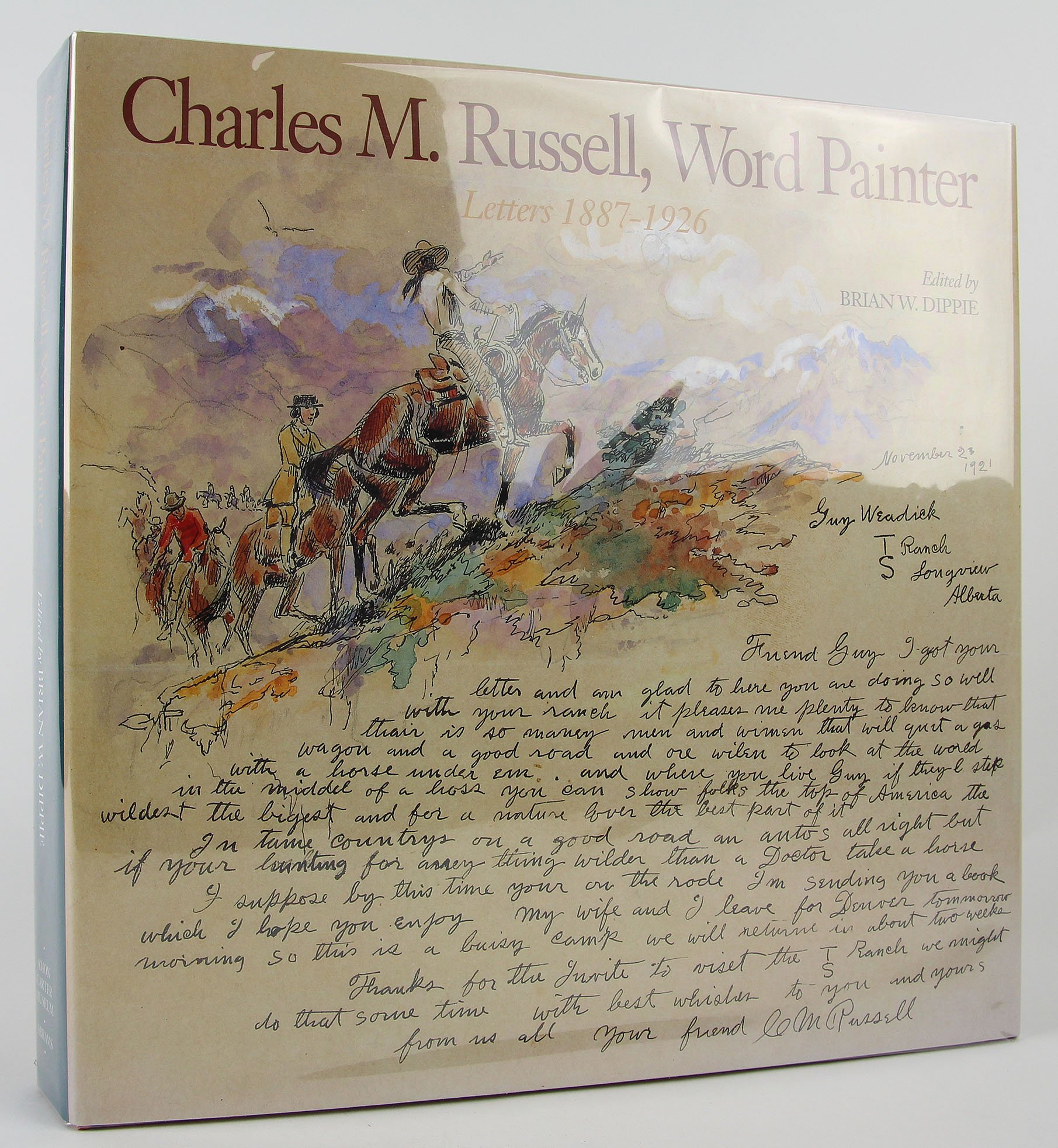
Charles M. Russell, Word Painter: Letters 1887-1926 is the most comprehensive collection of Russell's correspondence ever assembled. Letters to his wife Nancy, to patrons and fellow artists, and to the saloonkeepers and cowboys who remained his friends for life reveal a surprisingly modest man. Russell downplayed his own verbal skills, but his letters show that he was an artist with words as well as paint, able to evoke a bygone era or make a shrewd social observation in a few well-chosen sentences. Each letter is reproduced in facsimile, allowing readers to see, in the artist's own handwriting and with his inimitable spellings and punctuation, how Russell cleverly interwove colorful sketches and eloquent words to form a memorable whole. In the accompanying commentary, Brian Dippie places each of Russell's letters within the broader context of the artist's life and career. Dippie identifies the recipient of each letter and the circumstances that prompted the correspondence, clarifies Russell's references to other friends and acquaintances and, where appropriate, relates events in the letter to Russell's artistic development. Photographs, including many that belonged to the Russells, further illustrate the world that the artist and his friends inhabited. One of the two giants of Old West art (the other being Frederic Remington, of course) found it difficult to express his sentiments in words. So Charles M. Russell combined the words in his letters with watercolor pictures. Addressing such friends as Buffalo Bill Cody and Will Rogers, he adorned pages and envelopes alike with caricatures of his cowboy past and vignettes of his present life and travels. In letters to potential clients, most of them solicited by Russell's wife and business manager, Nancy (who, editor Brian W. Dippie speculates, also actually did some of the writing), Russell would submit more finished work. Often the letters would amount to preliminary versions of a more elaborate commission. In the case of a missive to Douglas Fairbanks in which Russell depicted the movie star as the principal hero of The Three Musketeers , the image he mailed inspired the bronze Fairbanks as D'Artagnan . So this selection of the cowboy artist's correspondence, served up in a virtual whale of an oversize tome replete with some 300 colorplates and nearly as many black-and-whites, has the occasional Trivial Pursuitish tidbit in it as well as enough to keep Old West art fans absorbed for hours. Edward Lighthart Charles M. Russell, Word Painter: Letters 1887-1926, is the most comprehensive collection of Russell's correspondence ever assembled. Letters to his wife Nancy, to patrons and fellow artists, and to the saloonkeepers and cowboys who remained his friends for life reveal a surprisingly modest man. Russell downplayed his own verbal skills, but his letters show that he was an artist with words as well as paint, able to evoke a bygone era or make a shrewd social observation in a few well-chosen sentences. Each letter is reproduced in facsimile, allowing readers to see, in the artist's own handwriting and with his inimitable spelling and punctuation, how Russell cleverly interwove colorful sketches and eloquent words to form a memorable whole. In the accompanying commentary, Brian Dippie places each of Russell's letters within the broader context of the artist's life and career. Dippie identifies the recipient of each letter and the circumstances that prompted the correspondence, clarifies Russell's references to other friends and acquaintances and, where appropriate, relates events in the letter to Russell's artistic development. Photographs, including many that belonged to the Russells, further illustrate the world that the artist and his friends inhabited. Brian W. Dippie is Professor of History at the University of Victoria, British Columbia. He has written several books and essays on the history and artists of the American West. "Between roundups, Russell painted pictures for pocket money or rode the grubline looking for a place to hang his hat. Thus the winter of 1886-87 found him at the O.H. Ranch on the Judith River when its owner, Jesse Phelps, received a letter from Lewis E. Kaufman, whose firm, Stadler & Kaufman, had placed several thousand head of cattle in his care. Kaufman had reason to worry about the condition of his herd: the range had been in poor shape throughout 1886 due to drought and overgrazing. "The grass...grew but slimly and cured before its time for lack of moisture," the Helena Independent reported in September. "Much depends upon the coming winter." Winter came early, in mid-November, and stayed; the snow drifted knee-deep. Ordinarily, warm winds or chinooks offered relief, melting the snow and uncovering the grass. But they proved fickle that winter, melting the snow just enough to form an icy crust that prevented the cattle from getting at what grass there was. Severe blizzards in late January and early February 1887 spelled di