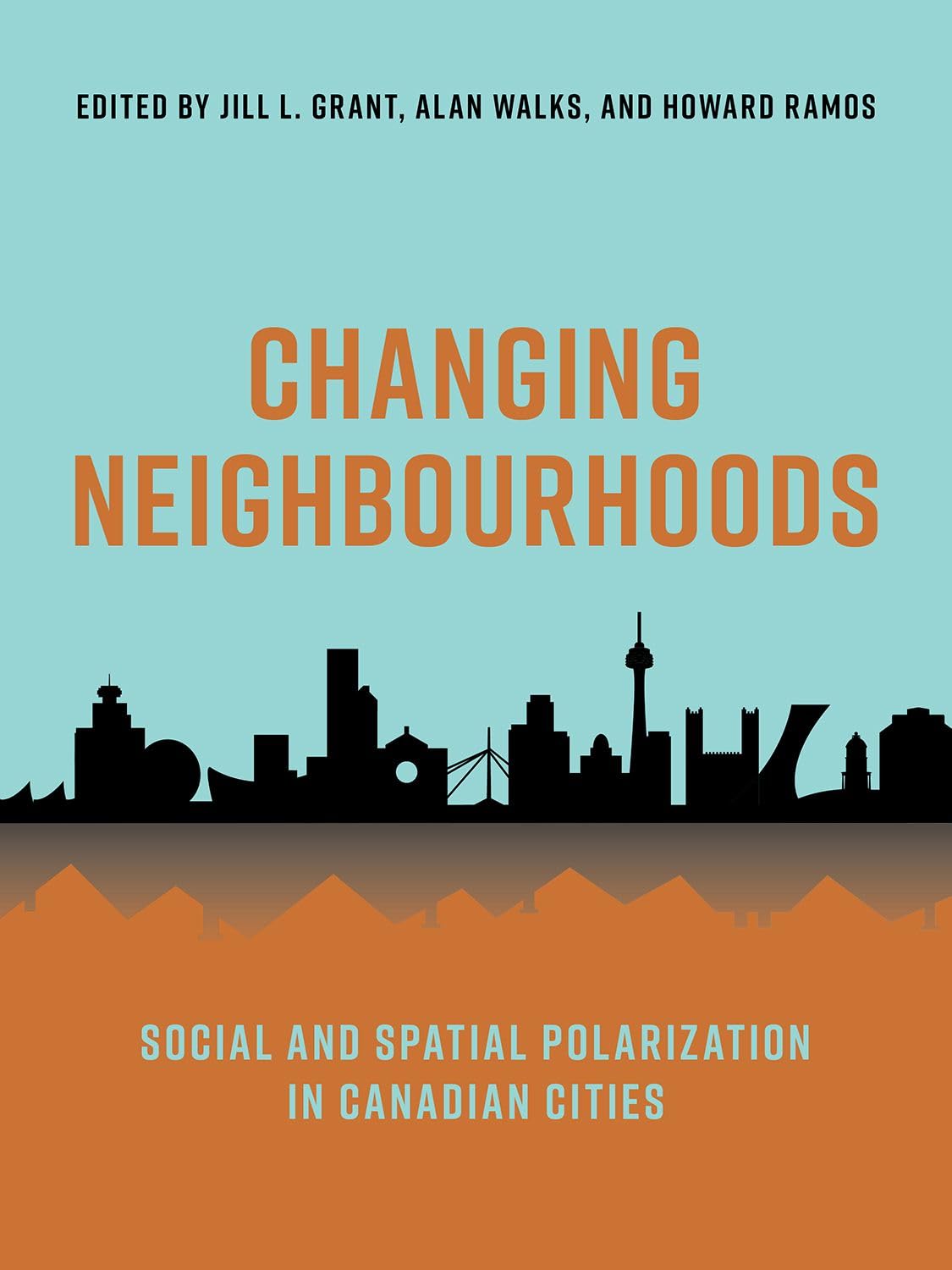
Canadians have a right to live in cities that meet their basic needs in a dignified way, but in recent decades increased inequality and polarization have been reshaping the social landscape of Canada’s metropolitan areas, changing neigbourhoods and negatively affecting the lived realities of increasingly diverse urban populations. This book examines the dimensions and impacts of increased economic inequality and urban socio-spatial polarization since the 1980s. Based on the work of the Neighbourhood Change Research Partnership, an innovative national comparative study of seven cities (Toronto, Montreal, Vancouver, Calgary, Winnipeg, Hamilton, and Halifax), the authors reveal the dynamics of neighbourhood change across the Canadian urban system. By mapping average income trends across neighbourhoods, they show the kinds of factors – social, economic, and cultural – that influenced residential options and redistributed concentrations of poverty and affluence. While the heart of the book lies in the project’s findings from each city, other chapter provide important context. The first three chapters discuss the trends, theories, and methodological puzzles that motivated the research and guided its development. The final two chapters offer reflections on lessons learned from the research and the implications for theory and practice. Taken together, they offer important understandings of the depth and the breadth of the problem at hand and signal the urgency for concerted policy responses in the decades to come. Overall, this is an important work for social geography and urban studies. -- M.E. Pfeifer ― CHOICE Connect Changing Neighbourhoods provides a timely and significant contribution to our understanding of the causes and consequences of social change at the neighbourhood level. -- Joshua Harold, Humber College ITAL ― Canadian Jewish Studies This book is an invaluable resource for planners, policy makers, NGOs, community activists, and students seeking to understand the driving forces behind neighbourhood change. -- Brian Doucet, Canada Research Chair in Urban Change and Social Inclusion, University of Waterloo, and editor of Why Detroit Matters: Decline, Renewal and Hope in a Divided City Sets the benchmark for future discussions about urban inequality in Canada. -- Nathanael Lauster, associate professor of sociology, University of British Columbia, and author of The Death and Life of the Single-Family House: Lessons from Vancouver on Building a Livable City Jill L. Grant is a professor emeritus of planning at Dalhousie University in Halifax, and a fellow of the Canadian Institute of Planners. She is the author or editor of five books and of dozens of scholarly articles. She has received several awards from the Canadian Institute of Planners and the Association of Collegiate Schools of Planning and has had articles included in prize-winning collections selected by the World Planning Schools Association. Alan Walks is a professor of urban geography and planning at the University of Toronto. He has published numerous scholarly articles related to urban inequality, gentrification, financialization, electoral geography, neighbourhood change, and housing policy, among other things. He is the editor of The Political Economy and Ecology of Automobolity: Driving Cities, Driving Inequality, Driving Politics (2015), and co-editor of The Political Ecology of the Metropolis (2013).Howard Ramos is a professor of sociology at Dalhousie University in Halifax. He is author or editor of four books. He has published on a wide range of social justice issues ranging from political mobilization, to human rights and equity issues, and perceptions of change.