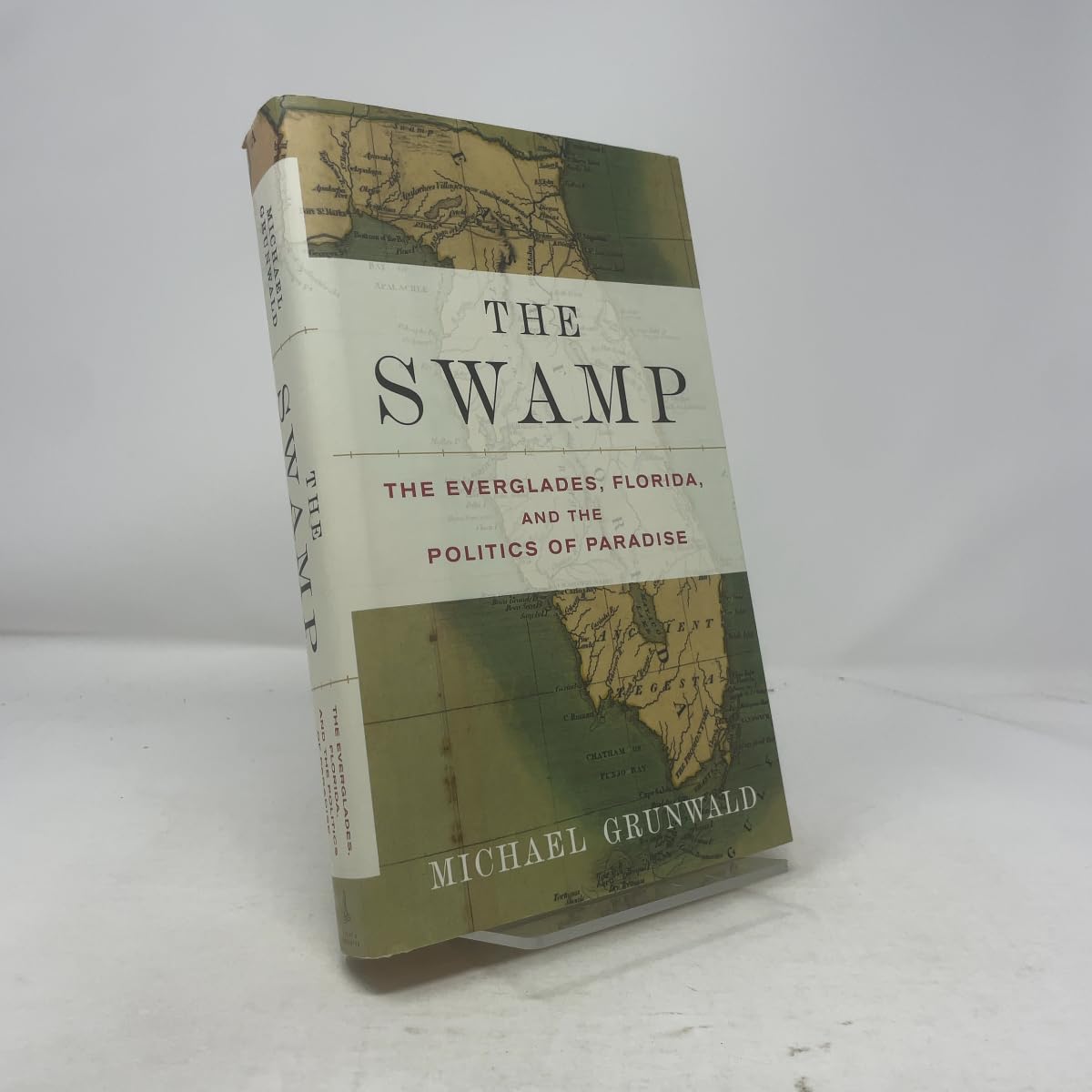
A history of the Everglades traces its emergence from the sea after the last ice age to its modern role as the world's largest ecosystem restoration project, an account marked by such events as Napoleon Bonaparte Borward's 1904 gubernatorial campaign, railroad and agricultural developments by the Army Corps of Engineers, and numerous political challenges. 35,000 first printing. The Swamp emerged from a four-part series that Grunwald wrote for the Washington Post in 2002, which focused on the $8 billion plan to restore the Everglades. From there, Grunwald fleshed out the Everglades's contested history. Critics laud The Swamp as an informative, beautifully researched and written tale that links social, political, and environmental history to current events. Many commented on Grunwald's finesse in describing the dreamers and schemers who sold Florida swampland, the engineers who tried to buck nature's forces. A few thought that Grunwald paid too little attention to current controversies, did not adequately explain today's Comprehensive Everglades Restoration Plan, and assumed a condition of ecological purity to pre-European contact Florida. These are minor complaints; Grunwald's unbiased story will provoke outrage over our squandered "river of grass." Copyright © 2004 Phillips & Nelson Media, Inc. *Starred Review* The phrase teeming with life could have been coined to describe the Everglades in its pristine state, but as Grunwald, an award-winning journalist for the Washington Post, so vividly describes, this vast Florida wetland has been under siege since the days of the conquistadors. As enterprising men attempted to drain, tame, and develop this fertile swamp, they wreaked ecological chaos instead, causing droughts, dust storms, wildfires, extinctions, pollution, and water shortages. Grunwald strikes just the right balance of awe, ire, and analysis in his expert and animated chronicle of the history of the Everglades, which encompasses the Seminole wars, a Reconstruction-era land rush, the notorious Roaring Twenties boom that made Florida swampland "a national punch line," the even more rampant and decimating postwar explosion, on to congressional battles over the beleaguered swamp during the Clinton and Bush years. Grunwald is especially captivating in his profiles of the Seminole warrior Osceola and Marjory Stoneman Douglas, of River of Grass fame, an Everglades activist until her death at 108. The colorful, infuriating, and instructive story of the Everglades is a riveting tale of ambition versus ecological reality, politics versus science, and, on the upside, our gradual awakening to the true nature of nature. Donna Seaman Copyright © American Library Association. All rights reserved In recent years, writers have devoted a lot of ink to the tortured history of south Florida's Everglades. But no one has nailed that story as effectively, as hauntingly and as dramatically as Michael Grunwald does in The Swamp, a brilliant work of research and reportage about the evolution of a reviled bog into America's -- if not the world's -- most valuable wetland. Grunwald, a prize-winning reporter for The Washington Post, explains that the true, original Everglades were not a swamp in any botanically correct sense of the word but rather a marsh, "a vast sheet of shallow water spread across a seemingly infinite prairie of serrated sawgrass," often called the River of Grass. But Grunwald's sweep is bigger than that. It embraces the entire south Florida hydrosystem, a 100-mile long funnel that seeps from the Kissimmee lakes near Orlando, spills into Lake Okeechobee, then overflows through the Everglades and the Big Cypress Swamp to the mangroves of Florida Bay and the Gulf of Mexico. At least that's the way it used to be. Now, despite recent efforts to undo some of the engineered damage inflicted on it over the past 150 years, the swamp remains imperiled. "Half the Everglades is gone," Grunwald writes. "The other half is an ecological mess. Wading birds no longer darken the skies above it." Okeechobee is choking on algal blooms. Sprawl continues to nibble the edge of the Big Cypress. Unsustainable communities "are at risk from the next killer hurricane -- and the one after that." Risk has been south Florida's leitmotif since Europeans first pushed their way into its wild interior. The region was certainly risky for the Seminole Indians, who barely escaped annihilation by the U.S. Army in the 1830s. Unconquered, a few hundred managed to hang on in the Big Cypress. Later in the 19th century, risk shifted to the great flocks of wading birds -- spoonbills, flamingos, herons and egrets -- whose plumage was thought better adorning milady's stylish hats. Before laws brought that slaughter to a halt, one report fixed the kill at 5 million birds a year. The most enduring risks were framed by the dreamers and schemers who believed that the Everglades must be drained to make the country fit for settlement and cultivat