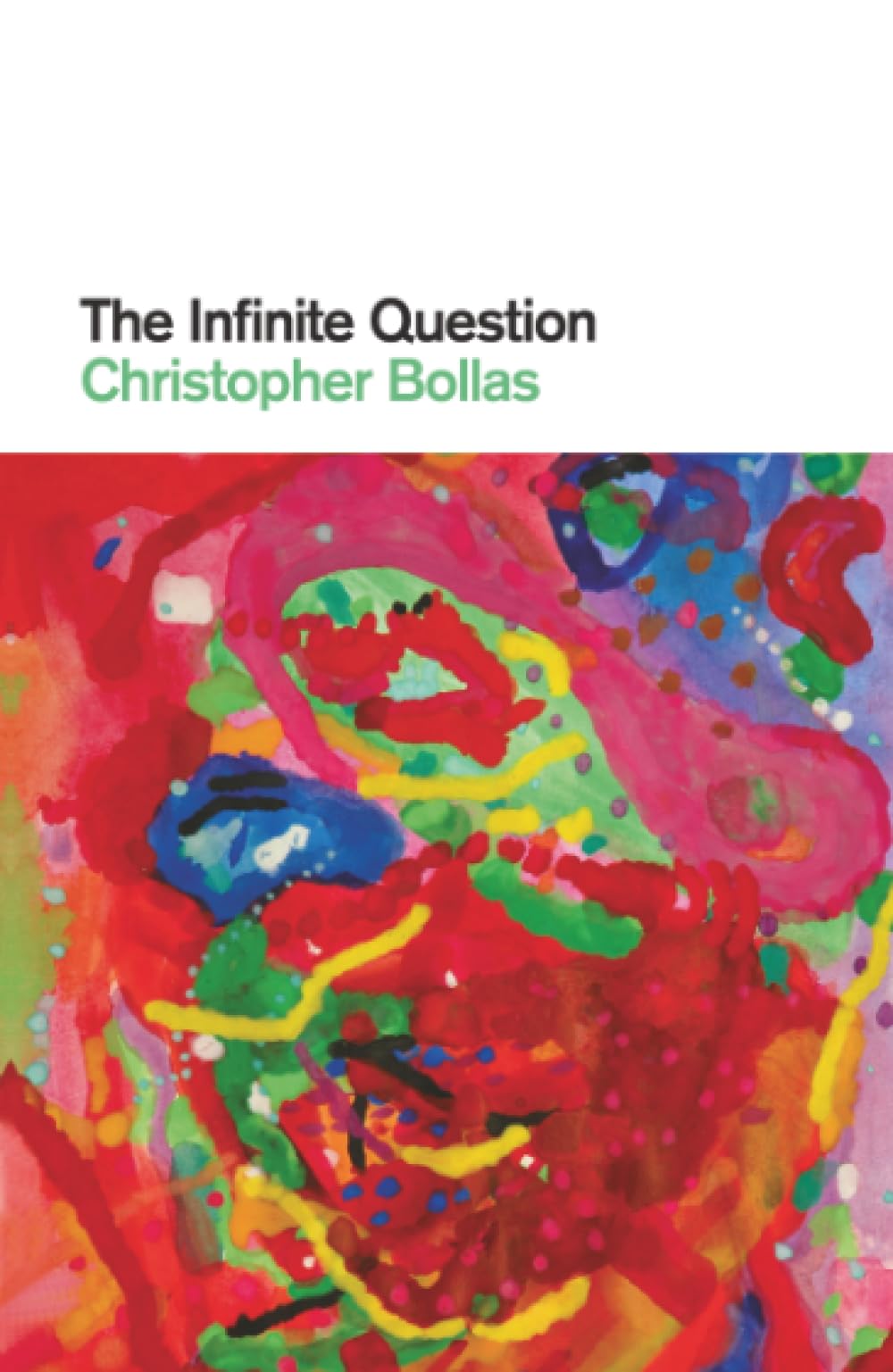
In his latest book Christopher Bollas uses detailed studies of real clinical practice to illuminate a theory of psychoanalysis which privileges the human impulse to question. From earliest childhood to the end of our lives, we are driven by this impulse in its varying forms, and The Infinite Question illustrates how Freud's free associative method provides both patient and analyst with answers and, in turn, with an ongoing interplay of further questions. At the book's core are transcripts of real analytical sessions, accompanied by parallel commentaries which highlight key aspects of the free associative method in practice. These transcripts are contextualised by further discussion of the cases themselves, as well as a wider theoretical framework which places its emphasis on Freud's theory of the logic of sequence: by learning to listen to this free associative logic, Bollas argues, we can discover a richer and more complex unconscious voice than if we rely solely on Freud's theory of repressed ideas. Bollas demonstrates, in an eloquent and persuasive manner, how the Freudian position of evenly suspended attentiveness enables the analyst's unconscious to catch the drift of the patient's own unconscious. He also shows that to stimulate further questioning is often of more benefit to the analytical process than to jump to an interpretation. Yet whatever fascinating course a session may take, neither the patient nor the analyst can halt the progress of the self-propelling interrogative drive. The Infinite Question will be invaluable to both the new student and the experienced psychoanalyst, read either on its own or as a practice-based extension of the theoretical ideas elaborated in its companion volume, The Evocative Object World (also published by Routledge). "I very much enjoyed reading these books [referring to both companion volumes]. There is something in the form of Bollas’s writing – in his character – that permeates these texts: a curiosity and passion for the unconscious life that never loses sight of its complexity. I wish that these books had existed while I was still in my training seminars, and I can only hope that they are going to be read both by students and experienced analysts over and over again. They contain a world to discover, much like unconscious life itself. They invite and stimulate the reader to deepen his or her unconscious creativity. The books have stimulated my curiosity and made me eager to try and learn more from my patients." - Anna Sylvén, The Scandinavian Psychoanalytic Review , Vol. 31, 2008 "…the experience of reading these books [referring to both companion volumes] is quite extraordinary. Beautifully written and evocatively simple, they incite the imagination and, mirroring his proposed psychoanalytic method, seem to invite the reader to muse and daydream… Perhaps Bollas’ most important contribution to clinical practice is that he reminds therapists to listen, to both the significant and the seemingly insignificant, and to get lost in the unconscious process at least sufficiently to evoke the object world and to keep questioning." – Carol Long, Psycho-analytic Psychotherapy in South Africa , Vol. 17 No. 1, 2009 "I very much enjoyed reading these books [referring to both companion volumes]. There is something in the form of Bollas’s writing – in his character – that permeates these texts: a curiosity and passion for the unconscious life that never loses sight of its complexity. I wish that these books had existed while I was still in my training seminars, and I can only hope that they are going to be read both by students and experienced analysts over and over again. They contain a world to discover, much like unconscious life itself. They invite and stimulate the reader to deepen his or her unconscious creativity. The books have stimulated my curiosity and made me eager to try and learn more from my patients." - Anna Sylvén, The Scandinavian Psychoanalytic Review , Vol. 31, 2008 "…the experience of reading these books [referring to both companion volumes] is quite extraordinary. Beautifully written and evocatively simple, they incite the imagination and, mirroring his proposed psychoanalytic method, seem to invite the reader to muse and daydream… Perhaps Bollas’ most important contribution to clinical practice is that he reminds therapists to listen, to both the significant and the seemingly insignificant, and to get lost in the unconscious process at least sufficiently to evoke the object world and to keep questioning." – Carol Long, Psycho-analytic Psychotherapy in South Africa , Vol. 17 No. 1, 2009 Praise for Bollas' previous books: "Christopher Bollas's illuminating and original [work] …is particularly valuable for the vividness with which it describes, not just analytic ideas, but what actually happens in the consulting room….a rigour, an intuitive boldness and a seriousness that might convert any critic of psychoanalysis." - The Listener "Chris