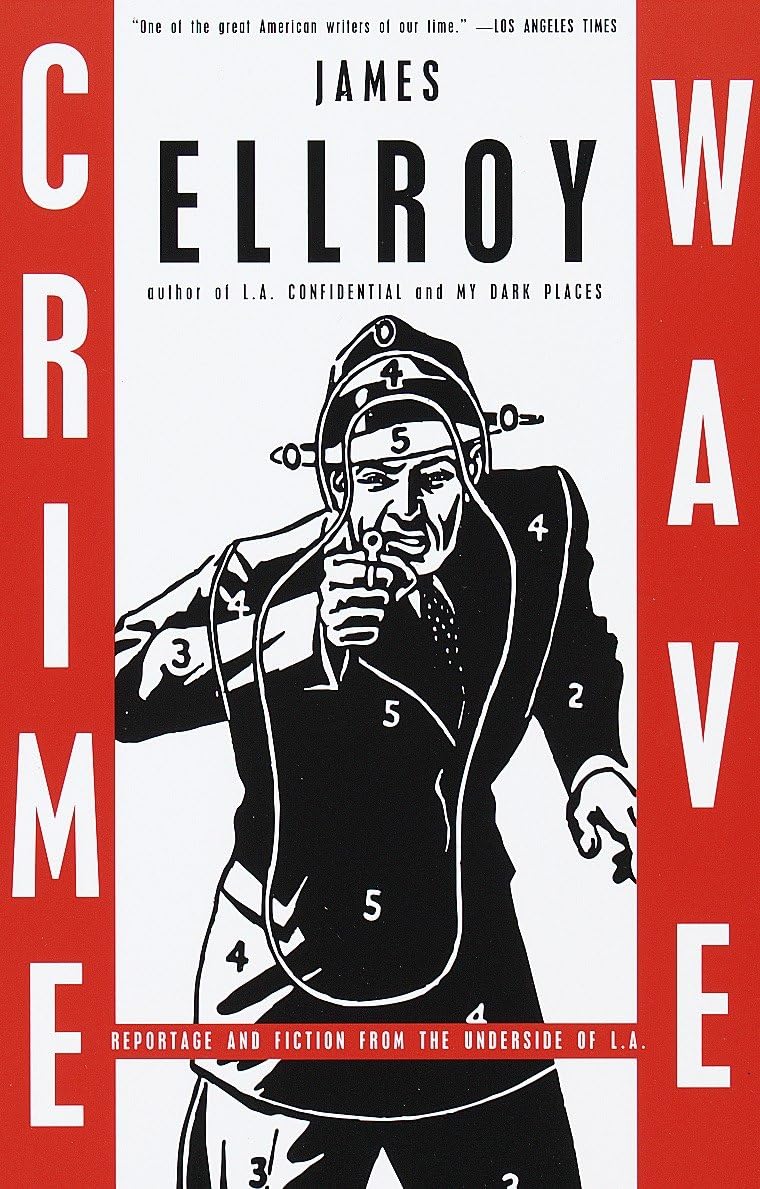
Los Angeles. In no other city do sex, celebrity, money, and crime exert such an irresistible magnetic field. And no writer has mapped that field with greater savagery and savvy than James Ellroy. With this fever-hot collection of reportage and short fiction, he returns to his native habitat and portrays it as a smog-shrouded netherworld where"every third person is a peeper, prowler, pederast, or pimp." From the scandal sheets of the 1950s to this morning's police blotter, Ellroy reopens true crimes and restores human dimensions to their victims. Sublimely, he resurrects the rag Hush-Hush magazine. And in a baroquely plotted novella of slaughter and corruption he enlists the forgotten luminaries of a lost Hollywood. Shocking, mesmerizing, and written in prose as wounding as an ice pick, Crime Wave is Ellroy at his best. You wouldn't expect slick GQ to perform the greatest magazine service to hard-boiled crime writing since the heyday of Black Mask , but the evidence is before your eyes: Crime Wave , James Ellroy's collected GQ works circa 1993-99. Though Crime Wave contains two stories in the exhilaratingly sleazy voice of the fictitious scandal rag Hush-Hush , and the novella-length "Hollywood Shakedown," a tale of sex, drugs, and murder starring '50s crooner-accordionist Dick Contino, the book is predominantly nonfiction. There's one flavorful piece, "Bad Boys in Tinseltown," about the day in 1967 when Ellroy--then a speed freak who broke into fancy houses to steal stuff and sniff women's underwear--read an article by Curtis Hanson raving about Bonnie and Clyde and was inspired. Then Ellroy flashes forward to 1996, when he visits Hanson as he directs the triumphant film version of L.A. Confidential . GQ talked Ellroy into writing about the event that made him a maniac, and then an obsessive writer: his dissolute mother's unsolved murder in 1958, when he was 10. His investigation of her death began with the chilling GQ article "My Mother's Killer," which grew into the book My Dark Places . (If you haven't heard Ellroy read it on audiotape, you haven't shivered.) His investigation of another woman's murder, "Body Dumps," is in some ways better, because there's a suspect to eviscerate in prose. "Sex, Glitz, and Greed," written about O.J. during the trial, is an odd fit in this collection, but when Ellroy is on his own turf--L.A.'s seamy, undead past--nobody can touch him. --Tim Appelo In Ellroy's crime novels (L.A. Confidential, Mysterious, 1990), Los Angeles of the 1940s and 1950s is not the city of angels but "a smog-shrouded netherworld... [where] every third person was a peeper, prowler, pederast, poon stalker, panty sniffer, prostitute, pillhead, or pimp." This collection of journalism and short stories, first published in GQ magazine between 1993 and 1998, reflects Ellroy's fascination with L.A's seamy side, an obsession that grew out of his mother's unsolved murder. "My mother's death corrupted and emboldened my imagination," he writes in "Body Dumps," an investigation in terse police-blotter prose of the second unsolved homicide in the history of El Monte, CA. The first had been of Geneva Hilliker Ellroy, 15 years earlier. Included here is the account of that crime, "My Mother's Killer," later expanded into the powerful My Dark Places (LJ 11/15/96). Scandal-plagued Hollywood is the focus of the fictional "Hush-Hush," "Tijuana, Mon Amour," and "Hollywood Shakedown," orgies of hard-boiled alliterations ("A sweaty swish with the shakes"), surreal violence, and black humor. Ellroy fans will lap this up.AWilda Williams, "Library Journal" Copyright 1999 Reed Business Information, Inc. A collection of disparate pieces all previously published in GQ, by a haunted master of the hard-boiled Los Angeles detective genre (L.A. Confidential, 1990; The Black Dahlia, 1987; etc.). Part one, titled ``Unsolved,'' groups three pieces, one of them an account of the murder of Ellroy's mother in El Monte, Calif., in 1958, which was later expanded to become My Dark Places (1996). This unsolved crime corrupted and emboldened'' his imagination, leading to a fascination with murder and police work and ultimately a career as a crime writer. The other two pieces recount the police investigation into El Monte's second unsolved murder 15 years later and the suspicious death of Karyn Kupcinet, a drug-addicted actress, in 1963. The two pieces of fiction in part two, ``Getchell,'' are a hilarious tour de force of alliteration (``Matted hair and maggot mounds on a mauve rug. Blood blips on white walls and windowpanes''), narrated by Danny Getchell, editor of Hush-Hush, a sleazy Hollywood scandal magazine. They are swiftly plotted tales of extortion, sex, murder, and mayhem peopled by celebrities, cops, drug dealers, and assorted LA lowlifes. Part three, ``Contino,'' focuses on Dick Contino, an accordion player of short-lived '50s fame. First is a nonfiction piece in which Ellroy tracks him down and intervi