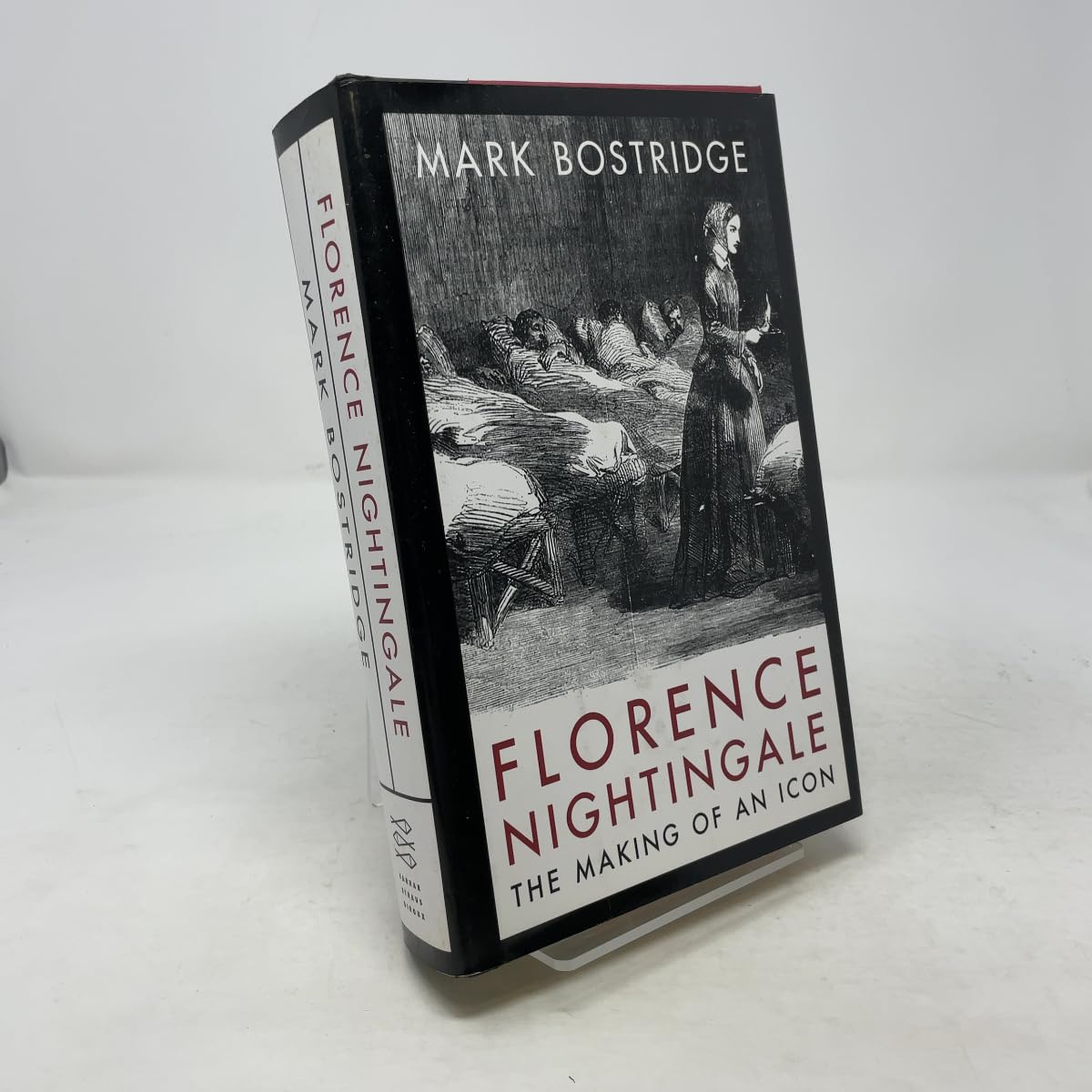
The common soldier’s savior, the standard-bearer of modern nursing, a pioneering social reformer: Florence Nightingale belongs to that select band of historical characters who are instantly recognizable. Home-schooled, bound for the life of an educated Victorian lady, Nightingale scandalized her family when she found her calling as a nurse, a thoroughly unsuitable profession for a woman of her class. As the “Lady with the Lamp,” ministering to the wounded and dying of the Crimean War, she offers an enduring image of sentimental appeal. Few individuals in their own lifetime have reached the level of fame and adulation attained by Nightingale as a result of her efforts. Fewer still have the power of continuing to inspire controversy in the way she does almost a century after her death. In this remarkable book, the first major biography of Florence Nightingale in more than fifty years, Mark Bostridge draws on a wealth of unpublished material, including previously unseen family papers, to throw new light on this extraordinary woman’s life and character. Disentangling elements of myth from the reality, Bostridge has written a vivid and immensely readable account of one of the most iconic figures in modern history. *Starred Review* Among the eminent Victorians, the figure of Florence Nightingale threatens to eclipse the celebrity of all the rest. Daughter of middling privilege and heiress to a tradition of freethinking in political, religious, and social matters, the sickly little girl had a will of steel and an unconventional view of her gender’s potential. Determined to offer humanity great service, the cultivated young woman fixated on nursing, which in the mid-nineteenth century was a function strictly for lower-class servant girls. Nightingale applied considerable organizational talent and persuasive rhetoric to conquer institutional inertia and care for the Crimean War’s wounded, becoming a heroine to those struggling against an entrenched and incompetent aristocracy. The British press’ wildly popular pictorial broadsheets romanticized her as an angel of mercy. Insisting she never sought fame, Nightingale nevertheless became the most recognized woman in the empire save the queen herself. Nightingale applied scientific, statistically based principles to health service in general, extending her impact far beyond her time and bettering all humanity. Bostridge strips through the myth of the Lady with the Lamp, and his detailed but always compelling prose shows a remarkable woman struggling to overcome prejudice and incompetence to bring health back to soldiers’ broken bodies. Without diminishing Nightingale’s singular achievements, Bostridge documents how much her success relied on others’ support. --Mark Knoblauch Mark Bostridge was born in 1961 and was educated at Oxford University. His biography of Vera Brittain, co-authored with Paul Berry, was selected as a book of the year by The Independent . He lives in England. Florence Nightingale Part OneDaughter of England 1820--54 My people were like children playing on the shore of the the eighteenth century. I was their hobby-horse, their plaything; and they drove me to and fro, dear souls! never weary of play themselves, till I, who had grown to woman's estate and to the ideas of the nineteenth century, lay down exhausted, my mind closed to hope, my heart to strength. FN, 'Cassandra', c. 1850--53 Woman stands askew. Her education for action has not kept pace with her education for acquirement. FN, The Institution of Kaiserswerth on the Rhine , 1851 To be alone is nothing -- to be without sympathy in a crowd -- this is to be confined in solitude. FN, untitled draft novel, c . 1850--531. The Ridiculous Name of NightingaleTake a walk south from the Porta Romana in Florence today, along the Via Senese, then turn westwards, and you will soon find yourself climbing a steep path along a narrow winding road. High stone walls, mossy and mottled with age, obliterate the view in either direction, but tall cypress trees line the route, and olives and vines run down to the walls on both sides.Towards the summit, at a bend in the road, a large house comes into view. The Villa La Colombaia is now a convent junior school with an imposing modern stone façade, but parts of the house date back to the fifteenth century. On its garden side the original low building with shuttered windows, arranged around a courtyard, is still in existence. A gravel walk through an elegantly laid-out garden leads to a magnificent view over the city, of Brunelleschi's white ribbed dome amid a sea of red rooftops.It was from this 'Maison de Campagne', on a spring day in 1820, that twenty-six-year-old William Nightingale wrote to his brother-in-law Ben Smith about the expected imminent arrival of his second child. The city of Florence itself seemed deserted -- everyone was travelling to Rome for Holy Week -- but William and his heavily pregnant wife Fanny were taking advantage