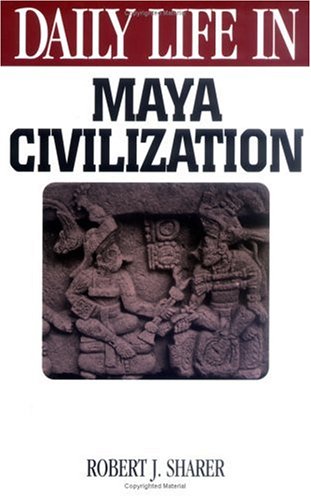
This examination of daily life in ancient Maya civilization presents the very latest discoveries and interpretations and corrects popular misconceptions. Based on the results of recent research from a variety of disciplines, it traces Maya civilization from its earliest beginnings to the Spanish conquest in the 16th century and shows how the Maya successfully adapted to their environment and preserved their traditional culture and lauguages from oppression over thousands of years. Archaeologist Sharer, one of the foremost experts on the Maya, offers unique insights into Maya civilization based on 30 years of living and working in Central America. Over 60 illustrations and photographs of Maya life, artifacts, and archaeological sites bring the social, political, economic, religious, and cultural aspects of Maya civilization to life. For ease of use by students, the work is organized into chapters covering all aspects of Maya life and civilization: the foundations of Maya life and civilization: early, middle, and late Maya civilization; economy (production and trade); social and political systems; life cycle events; religion; writing and calendars; and the variety of arts and crafts. The work closes with discussion of the meaning of Maya civilization for us today ― how the achievements and failures of the Maya past can be of benefit to the modern world. The work includes a historical timeline of Maya civilization and a bibliography for further reading. This work will replace all earlier resources on the Maya and will provide school and public librarians and students with the most up-to-date and historically accurate information on the Maya. Grade 8 Up. This thorough study of Mayan culture begins with a history of the development of this civilization over several thousand years. The author explains the effects of climate and terrain on population shifts and how archaeologists study sites and reconstruct societies from their findings. Following chapters discuss the rise and fall of royal dynasties, economic growth, social roles and strata, daily life, political organization, and religion. An in-depth examination of Mayan writing and numerical systems and the development of a complex calendrical record demonstrates the sophistication of this culture. An extensive bibliography is included. Black-and-white photographs of art, artifacts, excavations, and contemporary Mayan life as well as charts and a map extend the well-written text, but the book's overall appearance is bland and utilitarian. Carolyn Meyer and Charles Gallenkamp's The Mystery of the Ancient Maya (McElderry, 1994) is less detailed, but provides some colorful background information about earlier archaeological expeditions. Libraries needing comprehensive material about the Mayans will welcome Sharer's new title.?Cynthia M. Sturgis, Ledding Library, Milwaukee, OR Copyright 1997 Reed Business Information, Inc. This thorough study of Mayan culture begins with a history of the development of this civilization over several thousand years. The author explains the effects of climate and terrain on population shifts and how archaeologists study sites and reconstruct societies from their findings. Following chapters discuss the rise and fall of royal dynasties, economic growth, social roles and strata, daily life, political organization, and religion. An in-depth examination of Mayan writing and numerical systems and the development of a complex calendrical record demonstrates the sophistication of this culture....Libraries needing comprehensive material about the Mayans will welcome Sharer's new title. ROBERT J. SHARER is Shoemaker Professor in Anthropology at the University of Pennsylvania and Curator of the American Section at the University of Pennsylvania Museum. He has lived and worked in Central America for over 30 years, directing five major research projects for the University of Pennsylvania Museum in El Salvador, Guatemala, and Honduras. He is currently investigating the architechtural history of the Copan Acropolis in Honduras. He has written and/or edited more than 20 books and 60 articles and book chapters.