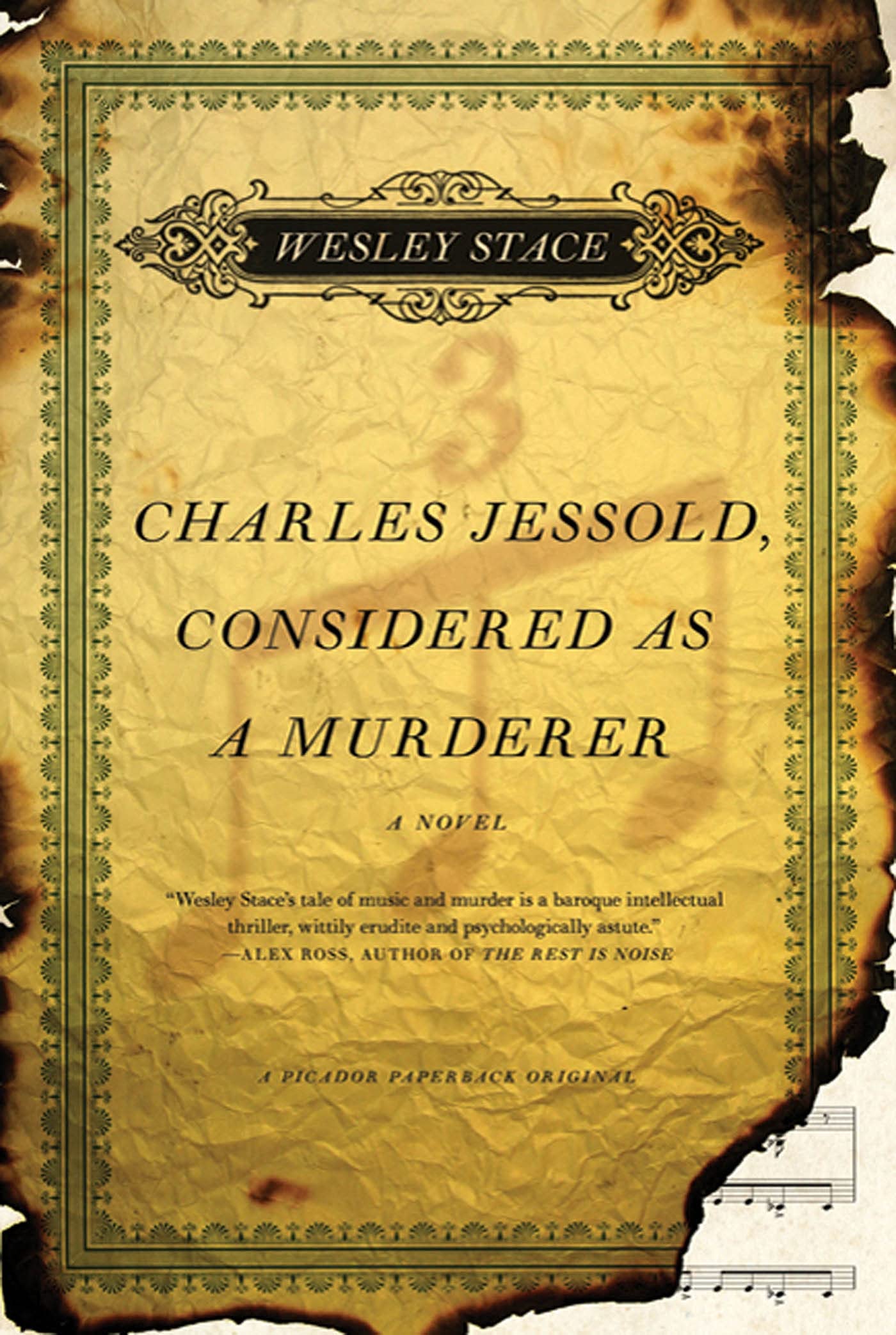
One of The Wall Street Journal' s Best fiction books of 2011 England, 1923. A gentleman critic named Leslie Shepherd tells the macabre story of a gifted young composer, Charles Jessold. On the eve of his revolutionary new opera's premiere, Jessold murders his wife and her lover, and then commits suicide in a scenario that strangely echoes the plot of his opera---which Shepherd has helped to write. The opera will never be performed. Shepherd first shares his police testimony, then recalls his relationship with Jessold in his role as critic, biographer, and friend. And with each retelling of the story, significant new details cast light on the identity of the real victim in Jessold's tragedy. This ambitiously intricate novel is set against a turbulent moment in music history, when atonal sounds first reverberated through the concert halls of Europe, just as the continent readied itself for war. What if Jessold's opera was not only a betrayal of Shepherd, but of England as well? Wesley Stace has crafted a dazzling story of counter-melodies and counter-narratives that will keep you guessing to the end. Writing music is murder in novelist and musician Stace�s thriller set in 1920s Great Britain. As the novel opens, the premiere of gifted young composer Charles Jessold�s new opera, Little Musgrave, is upstaged, in the deadliest of ways, when Jessold kills his wife and her lover, then takes his own life. More shocking still: the composer�s brutal crimes are strikingly similar to those portrayed in his new work. Narrated by a respected music critic, Leslie Shepherd, Stace�s latest offering recounts the years leading up to Jessold�s crime, as Shepherd relishes (and occasionally dreads) his role as the composer�s collaborator and friend. What was it that pushed Jessold over the edge? Was he having an affair with Shepherd�s lovely wife, or was the pair�s relationship simply one of artist and muse? Stace (By George, 2007) starts with a bang (literally), but the tale loses some momentum as Shepherd belabors the details of his own life. Still, music-history fans will enjoy Stace�s take on the emergence of modernism in concert venues across prewar Europe. --Allison Block “A tremendously imaginative novel that's really several novels in one, for beneath its sparkling surface there are some very murky depths. A wonderfully disquieting read.” ― Sarah Waters, author of The Little Stranger “This is one of the few novels I have read that is truly musical. Wesley Stace is a brilliant and intensely original writer and this is his most unusual book yet.” ― Audrey Niffenegger, author of The Time Traveler's Wife “A gripping narrative that twists and turns to the end...By far the most confident musical fiction I have read in years.” ― Norman Lebrecht, New Statesman (UK) “Wesley Stace's tale of music and murder is a baroque intellectual thriller, wittily erudite and psychologically astute.” ― Alex Ross, author of The Rest Is Noise “We might have predicted that Wesley Stace---a fine novelist and a fine musician---would one day write a novel about music, but could we have predicted that it would be so brilliant? The dialogue sparkles, the prose glimmers, and for once you leave a novel not just haunted by the characters and the story, but humming the tunes.” ― Jonathan Coe, author of The Rotters' Club “[Stace's] twisty plot of jealousy and murder unfolds with Nabokovian precision during Britain's early twentieth-century folk and early music revival.” ― Ludovic Hunter-Tilney, Financial Times (UK) “Recalls one of the greatest and saddest novels of the period, Ford Madox Ford's The Good Soldier and follows the tradition of great novels of imaginary music.” ― Roz Kaveney, The Times Literary Supplement (UK) Wesley Stace is the author of the international bestseller Misfortune , by George , and Charles Jessold, Considered as a Murderer . He has released fifteen albums under the name John Wesley Harding, and he lives in Philadelphia. Charles Jessold, Considered as a Murderer By Wesley Stace Picador Copyright © 2011 Wesley Stace All right reserved. ISBN: 9780312680107 I met Charles Jessold, the murderer, on 21 May 1910, the day after King Edward’s funeral. We were guests at a Hatton Manor Saturday-to-Monday, and it was on that very fi rst eve ning that I had occasion to tell of Carlo Gesualdo, the composer whose story made such a lasting impression. I had just entered the room, a quick inventory of which revealed: three composers (one of note, two of naught), a conductor, and a miscellany of vicars, musical scholars and enthusiasts; not to mention Cedric Mount (our most esteemed member) and of course Antic Jackson who, despite arriving on the same late train from town, had managed to beat me downstairs. I was, as ever, the token musical critic. The only stranger was a young man standing over the piano. In impeccably creased grey flannels and gaudily striped tie, he was our