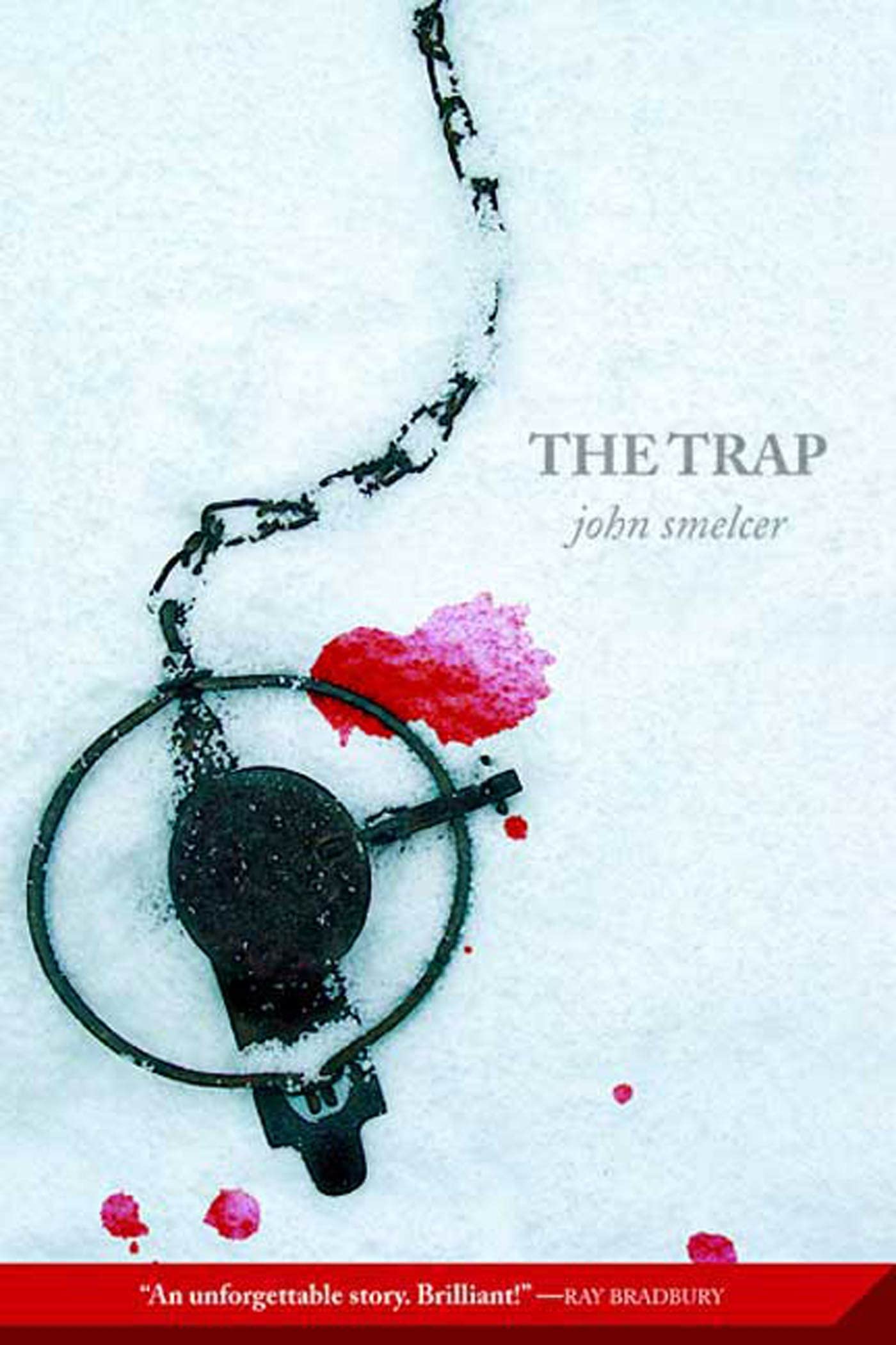
Seventeen-year-old Johnny Least-Weasel knows that his grandfather Albert is a stubborn old man and won't stop checking his own traplines even though other men his age stopped doing so years ago. But Albert Least-Weasel has been running traplines in the Alaskan wilderness alone for the past sixty years. Nothing has ever gone wrong on the trail he knows so well. When Albert doesn't come back from checking his traps, with the temperature steadily plummeting, Johnny must decide quickly whether to trust his grandfather or his own instincts. Written in alternating chapters that relate the parallel stories of Johnny and his grandfather, this novel poignantly addresses the hardships of life in the far north, suggesting that the most dangerous traps need not be made of steel. “An unforgettable story. Brilliant!” ― Ray Bradbury “In THE TRAP, John Smelcer takes his readers into a frozen world, and keeps us there with a gripping example of talented storytelling. Unforgettable.” ― Tony Hillerman “THE TRAP is a lovely story, beautifully told, the kind that makes you wade in and sink warmly into the cold, cold north of Alaska.” ― Winston Groom, author of Forrest Gump “First novelist John Smelcer takes readers to the Alaskan Arctic Circle for an unforgettable survival tale.” ― The Horn Book JOHN SMELCER is the author of many nonfiction and poetry books for adults, as well as a young adult novel, The Trap . Mr. Smelcer has been a visiting professor at various universities around the world and is the associate publisher and poetry editor of the literary magazine Rosebud . The Trap By John Smelcer Holtzbrinck Publishers Copyright © 2006 John Smelcer All rights reserved. ISBN: 978-0-312-37755-7 Contents Title Page, Copyright Notice, Dedication, Acknowledgments, The First Day, The Second Day, The Third Day, The Fourth Day, Gofish, Copyright, CHAPTER 1 Back before white men were searching for gold in the hills and streams of this North Country, there was a village much like any other small village nestled along the great river. One fall, several young men went moose hunting. A man asked if he could join them, even though he was very old and slow. Reluctantly, the young men let him come along. Off in the distance, in a place far away from anyplace else, a yellow snowmobile pulling a long sled was slowly coming down toward the wide river through a valley of white hills, winding around trees, traversing over knolls and rises, sometimes becoming visible, sometimes moving unseen. The sun was already at its highest point, which was barely above the rim of the blue-edged horizon. That's the way it had been for the past month and the way it would be for at least another month to come. Winter this far north was a series of short days and long nights, with mostly cold and silence in between — a time when most living things huddled or slept through the intolerable cold and dark. It had snowed during the night, which, like the prolonged darkness, was nothing new. It always snowed here, more so in the mountains, and the wind swept the whiteness against trees and deadfalls and the steep banks of streams or lakes. To escape the pitiless wind, sled dogs learned to dig down into the snow and to curl up into tight balls with their long, bushy tails covering their noses and eyes like fur quilts. They'd sleep that way all night, cold and dreaming of summer and sunlight warm upon them. Sometimes the snow buried sleeping moose or cabins, drifted over backcountry trails, and concealed treacherous openings in the great river far below, the river that wound itself through the floodplain to the sea. They say the People of the North have a hundred names for snow. This may not be completely true, but anyone who has lived any time on a frozen land knows that snow has more than one name. There is sleet, and hail so big around that the sound of it falling on a tin roof is deafening. There are dry, soft flakes that fall gently without hurry or anger, like the lazy flakes in a Christmas-card scene. There is wet snow that sticks to the branches of trees, turns to ice, and breaks their limbs when too much has gathered. Some snow falls straight down, some slantwise, and some from everywhere, even from beneath, as if the freezing earth itself is storming. There is powder snow, which, when loosely settled on a field or valley, creates an almost religious experience for those fortunate enough to be the first to break trails, leaving their long, unbroken signatures on the snow-clad landscape. Sometimes, when conditions are right, there is granulated snow, like sugar, loosely packed and crystalline, which gives teeth to the wind. After a very cold night, when the cold pulls out all moisture from the air, there is dry snow. On a warm winter day, a rare day, the low sun melts only the thinnest layer of snow closest to the surface and then refreezes it at night. This is crusted snow. After a trail is broken into the backc