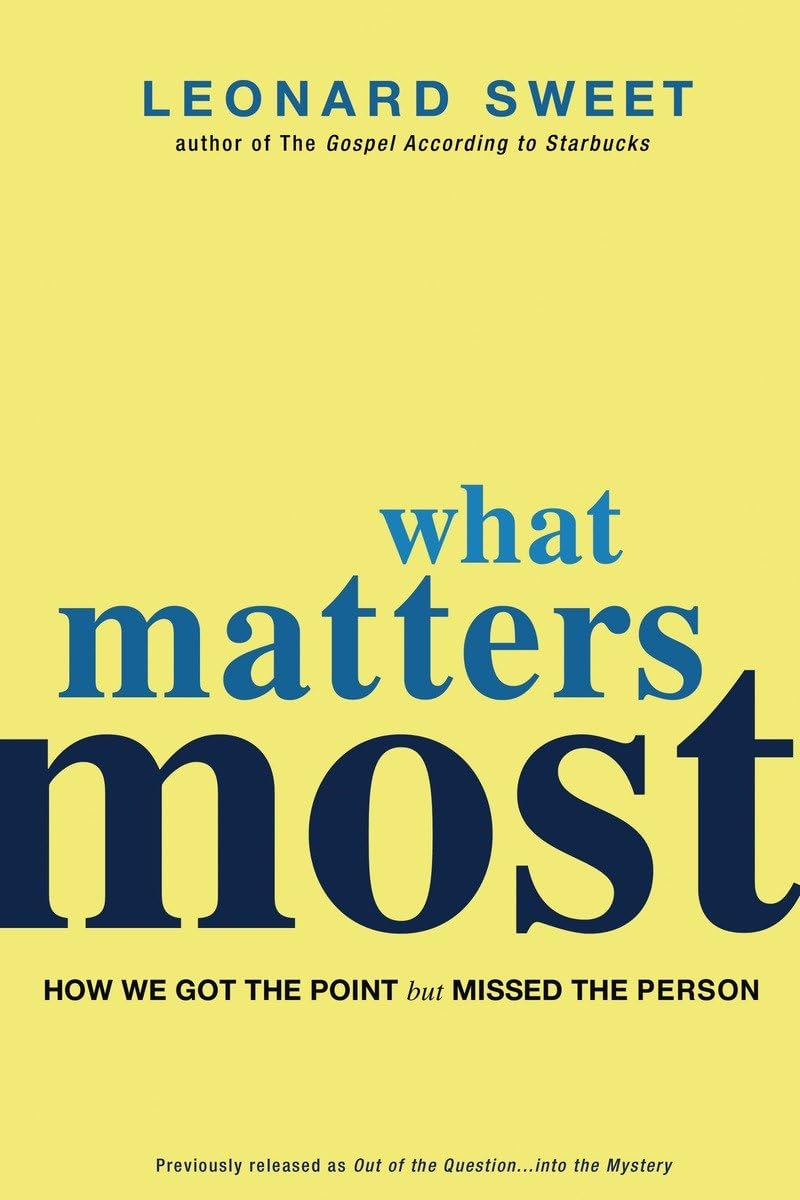
Belief can exist in isolation, but faith requires a relationship Why wade in the shallows of belief when you can plunge into the depths of faith? Belief involves a different way of thinking, but faith brings about a new way of living. It grows through direct experience and a close relationship, both of which come as you follow Jesus. As Christians we often talk about developing a “personal relationship” with Christ, but instead of pursuing a relationship, we pursue knowledge. We are tempted to place confidence in our definite, settled beliefs, which offer a pale substitute for the daily adventure of an honest relationship with Jesus. In What Matters Most, Leonard Sweet presents a challenging and compelling approach to belief that is joined by dynamic engagement with God. You are invited to explore the uncharted regions of faith by following Jesus, completely on his terms. Once you begin, you will never go back to mere belief. Praise for What Matters Most “Len Sweet has really done it this time! In true midrash form, Len exposes the beauty of a relationship with our Creator. He asks all the hard questions and leads us to a place of grace beyond the formulaic answers. Throw all your selfhelp books in the trash and immerse yourself in a book that will help you see your faith journey in a whole new way.” —CHRIS SEAY, author of The Gospel According to Tony Soprano “No charts, no boxes, no to-do lists. Just everything we thought we knew about faith but didn’t. This is the book we should be reading in our small groups.” —SALLY MORGENTHALER, author of Worship Evangelism , founder of Sacramentis.com and Digital Glass Videos “Way back in the 1970s, some thoughtful Christian leaders began talking about a relational theology. The term held intrigue and promise. Now, Leonard Sweet has given us a great gift. Here is a panoramic view of what a relational theology can mean for Christians today. Whether you’re a spiritual seeker trying to get the lay of the land, or a seasoned traveler trying to make sense of what you’ve experienced, or even a disillusioned leader who feels it’s all gone stale—this book will help you see in a fresh, inspiring, profound, and invigorating way.” —BRIAN MCLAREN, author of A New Kind of Christian and The Church on the Other Side Leonard Sweet , PhD, is founder and president of SpiritVentureMinistries and is a professor at Drew University in New Jersey and a visiting professor at George Fox University in Oregon. A leading social critic and cultural observer, Sweet is considered one of the most influential Christians in America. He is the chief writer for Sermons.com and has authored numerous books that have changed Christian thinking, including The Gospel According to Starbucks, Soul Tsunami, and Jesus Manifesto (with Frank Viola). An internationally known speaker and preacher, Sweet lives on an island in northern Washington state. WHERE DID WE MISS THE PERSON AND GET THE POINT INSTEAD? We know how to save the world. We just don’t realize that we know what we know. The way to save the world is not through more rules to live by, but through right relationships to live for. People are fast losing the art of being with one another. So it’s not surprising that the number one problem in the world is people’s living disconnected lives. They are detached from God, from others, and from creation. People are losing the art of living with one another. Relationship is the soul of the universe. And the soul is sick. How sick? So sick that the worlds of business and finance are proclaiming a biblical truth that the church has lost: “The Right Relationship Is Everything.” 1We have entered a relationship economy where high-quality customer relationships are the key competitive advantage. When you purchase a cell phone, the cell-phone company takes a loss. Why? Because they aren’t selling cell phones, they’re seducing you into a long-term relationship. (Ever try to get out of one of these “committed relationships”?) Real estate developers no longer sell houses, they sell relationships.2 In more and more cities and suburbs, new houses are designed with a retro look—the most prominent feature being a large front porch. And in more and more new subdivisions, houses are grouped together in a friendly arrangement that caters to neighbors getting to know one another. Walking trails and community greenbelts, neighborhood playgrounds and even community garden plots, all underscore the importance of spending time with other people. You might need a house, but you want a relationship. When I consider that I’m more intimately involved with two of my credit cards—American Express and Starbucks—than I am with the family that lives three doors down the street, then it’s time to rethink relationship. Did you know that American Express keeps a detailed transcript of every conversation they have with their customers? I found this out when the check I used to pay my bill bounced. As soon as I r