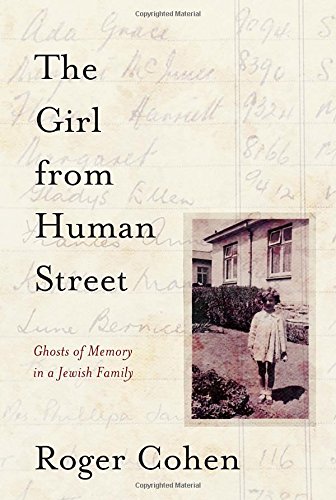
An intimate and profoundly moving Jewish family history—a story of displacement, prejudice, hope, despair, and love. In this luminous memoir, award-winning New York Times columnist Roger Cohen turns a compassionate yet discerning eye on the legacy of his own forebears. As he follows them across continents and decades, mapping individual lives that diverge and intertwine, vital patterns of struggle and resilience, valued heritage and evolving loyalties (religious, ethnic, national), converge into a resonant portrait of cultural identity in the modern age. Beginning in the nineteenth century and continuing through to the present day, Cohen tracks his family’s story of repeated upheaval, from Lithuania to South Africa, and then to England, the United States, and Israel. It is a tale of otherness marked by overt and latent anti-Semitism, but also otherness as a sense of inheritance. We see Cohen’s family members grow roots in each adopted homeland even as they struggle to overcome the loss of what is left behind and to adapt—to the racism his parents witness in apartheid-era South Africa, to the familiar ostracism an uncle from Johannesburg faces after fighting against Hitler across Europe, to the ambivalence an Israeli cousin experiences when tasked with policing the occupied West Bank. At the heart of The Girl from Human Street is the powerful and touching relationship between Cohen and his mother, that “girl.” Tortured by the upheavals in her life yet stoic in her struggle, she embodies her son’s complex inheritance. Graceful, honest, and sweeping, Cohen’s remarkable chronicle of the quest for belonging across generations contributes an important chapter to the ongoing narrative of Jewish life. "Empathetic and far-reaching... The imaginative empathy that he brings even to the secondary figures depicted here...is sometimes breathtaking... Cohen's book is written with a generosity that is truly humane." — The New York Review of Books “Beautifully crafted….[Cohen] reveals how the threads of [his] legacy of displacement are woven together, all the while making visible tears in the fabric never to be fully mended.” — The Washington Post “There is so much to admire in The Girl from Human Street . Cohen[’s]…suggestion that certain depressive natures are triggered, or more to the point, haunted, by their immigrant history, is profound. His memoir will linger in any reader’s memory.” — USA Today “Cohen places the particular experiences of his family in a large historical frame….In his instructive meditations on history and Jewish life, Cohen…catches virtually the entire twentieth century.” — The New York Times Book Review “Impressive….[Cohen’s] moving, beautifully written book may be a ‘story of the 20th century’, but it also explores how Jewish identity might evolve in the 21st.” —Ian Critchley, The Sunday Times “ The Girl from Human Street has important things to say, things that can perhaps only be said by a Jewish author. Cohen’s book is brave, honorable and enlightened. It is also beautifully written.” —The Telegraph “A moving, complex story that traces a family’s century of migration.” — The Financial Times " By tracing where his mother came from...[Cohen] speaks universally in this disarmingly raw narrative, and his lovely but haunted mother even more so – not least in her refusal to give up trying to love ." — The Guardian “[As with] Amos Oz’s A Tale of Love and Darkness …we are in the hands of a master stylist….As a writer [Cohen] is peerless among his journalist colleagues.” — Haaretz “Cohen...explores the tentacles of repressed memory in Jewish identity….Thoughtful, wide-ranging, he muses on his own migrations spurred by ‘buried truths.’” — Publishers Weekly “Exquisite….[Cohen] writes with a poetic fragility…always striving for moral clarity, even when his own inner contradictions and complexities impede him.” — The Jerusalem Post “Many others have written stories of their family’s roots and journeys, but Cohen’s work stands out for his poetic and powerful prose.” — The Jewish Week “Cohen knows the pleasures and also the loneliness of diaspora. In writing his stirring memoir, in constructing a past with which he can live, he wrestled with demons both historical and personal.” — The Huffington Post “Vibrant, unusual and staunchly poignant….It is in fact not one, but many books: a lingering, evocative memoir, a gripping narrative, a shrewd socioeconomic history of South Africa, Britain, Israel, the US and Eastern Europe, a piercing philosophical analysis of the ethics of memory, of belonging to a story. It is quite unflinchingly an inquiry into the moral prerequisites of being human.” — Bookanista “Honest and lucid…With limpid prose, Cohen delivers a searching and profoundly moving memoir.” — Kirkus , starred review “Insightful, sometimes controversial commentary on crucial contemporary issues.” — Booklist “A gifted journalist, who has powerfully conveyed the gri