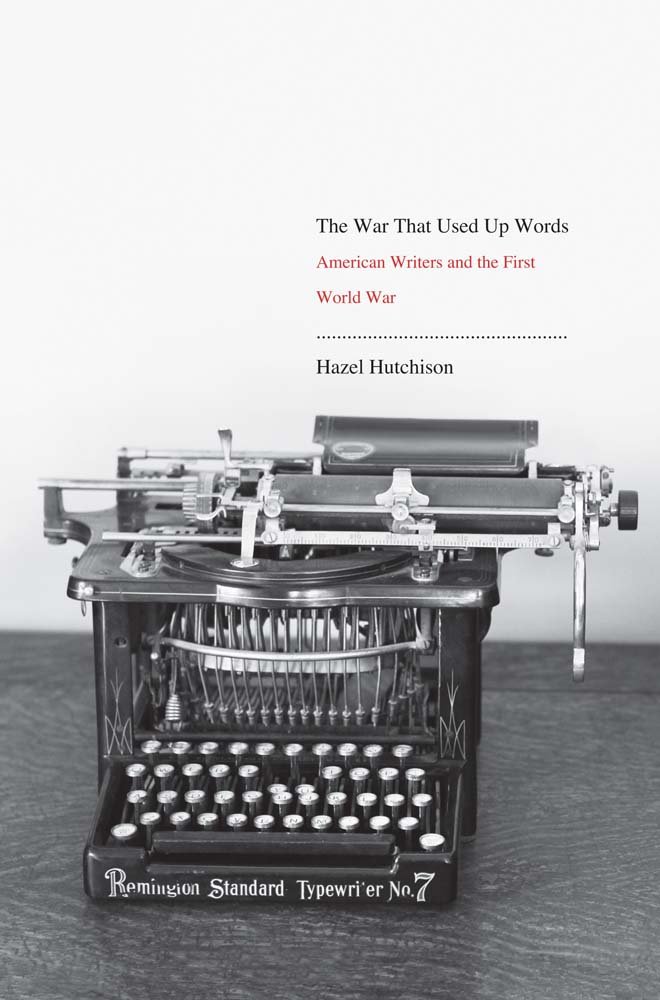
In this provocative study Hazel Hutchison takes a fresh look at the roles of American writers in helping to shape national opinion and policy during the First World War. From the war's opening salvos in Europe American writers recognized the impact the war would have on their society and sought out new strategies to express their horror support or resignation. By focusing on the writings of Henry James Edith Wharton Grace Fallow Norton Mary Borden Ellen La Motte E. E. Cummings and John Dos Passos Hutchison examines what it means to be a writer in wartime particularly in the midst of a conflict characterized by censorship and propaganda. Drawing on original letters and manuscripts some never before seen by researchers this book explores how the essays poetry and novels of these seven literary figures influenced America's public view of events from August 1914 through the Paris Peace Conference of 1919 and ultimately set the literary agenda for later more celebrated texts about the war. “Hutchison has written an outstanding overview of the literature that began within months of the start of WW I and flooded world reading markets.”— Choice “Hutchison’s book eloquently details shifting notions of civilization, art, and the impact of the written word.”—Sarah Wood Anderson, Journal of American History "This book explores the struggle of American writers to make sense of a war that grew beyond their wildest expectations. No American exceptionalism here; just perplexity, sadness and resignation at the degeneration of warfare into mass slaughter."—Jay Winter, Yale University “ The War That Used Up Words is a beautifully written reexamination of American writers in the midst of the Great War that persuasively challenges longstanding critical assumptions and forces us to rethink the literary history of the late 1910s. There isn’t a single inelegant sentence.” —Steven Trout, University of Southern Alabama “Hutchison’s scrutiny of the testimonies and literary engagements of American authors during the First World War: men and women, the elderly and the teenage, the familiar and the neglected is coupled with a surefooted description of changing US politics and public opinion as the war developed. She has researched this study meticulously.”—Tim Kendall, University of Exeter Hazel Hutchison teaches British and American literature at the University of Aberdeen. She is the author two previous works, Seeing and Believing: Henry James and the Spiritual World and Brief Lives: Henry James . The War That Used Up Words American Writers and the First World War By Hazel Hutchison Yale UNIVERSITY PRESS Copyright © 2015 Hazel Hutchison All rights reserved. ISBN: 978-0-300-19502-6 Contents Acknowledgments, ix, Introduction, 1, ONE 1914—Civilization, 27, TWO 1915—Volunteers, 67, THREE 1916—Books, 118, FOUR 1917—Perspectives, 161, FIVE 1918—Compromises, 202, Aftermath, 236, Notes, 243, Bibliography, 269, Index, 283, CHAPTER 1 1914—Civilization The future is very dark in Europe, and to me it looks as if we were entering upon a period quite new in history.... Whether our period of economical enterprise, unlimited competition, and unrestrained individualism, is the highest stage of human progress is to me very doubtful; and sometimes when I see the existing conditions of European (to say nothing of American) social order, bad as they are for the mass alike of upper and lower classes, I wonder whether our civilization can maintain itself against the forces which are banding together for the destruction of many of the institutions in which it is embodied, or whether we are not to have another period of decline, fall, and ruin and revival, like that of the first thirteen hundred years of our era. It would not grieve me much to know that this were to be the case. No man who knows what society at the present day really is, but must agree that it is not worth preserving on its present basis. These were strong words—but they were not about the Europe of 1914. Disillusionment, disgust and the anticipation of disaster lend a sharply modern tone, but this was Charles Eliot Norton (1827–1908), editor, art critic, and educator, writing home to America in 1869 as he toured Britain, Italy, Germany, and France. Over sixty years later, as Europe yet again spiraled into unrest, T. S. Eliot would quote this passage in his lectures in honor of Norton at Harvard University in 1932. To Eliot, Norton stood for the viewpoint that culture was the mainstay of a decent society. Without it, everything came to ruin. As Eliot put it, "the people which ceases to care for its literary inheritance becomes barbaric; the people which ceases to produce literature ceases to move in thought and sensibility." Henry James wrote to Edith Wharton in August 1914 that he felt "all but unbearably overdarkened by this crash of our civilization." But this was a crash that had been a long time coming, and which would not prov