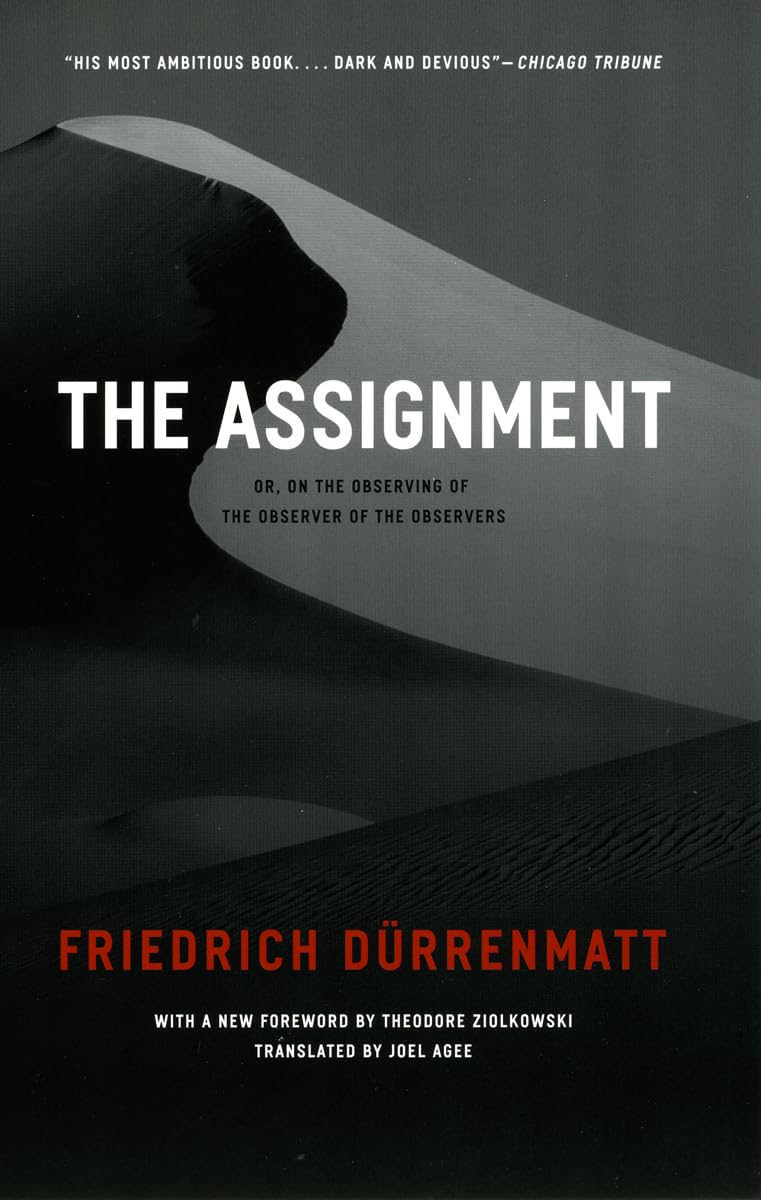
In Friedrich Dürrenmatt’s experimental thriller The Assignment , the wife of a psychiatrist has been raped and killed near a desert ruin in North Africa. Her husband hires a woman named F. to reconstruct the unsolved crime in a documentary film. F. is soon unwittingly thrust into a paranoid world of international espionage where everyone is watched—including the watchers. After discovering a recent photograph of the supposed murder victim happily reunited with her husband, F. becomes trapped in an apocalyptic landscape riddled with political intrigue, crimes of mistaken identity, and terrorism. F.’s labyrinthine quest for the truth is Dürrenmatt’s fictionalized warning against the dangers of a technologically advanced society that turns everyday life into one of constant scrutiny. Joel Agee’s elegant translation will introduce a fresh generation of English-speaking readers to one of European literature’s masters of language, suspense, and dystopia. “The narrative is accelerated from the start. . . . As the novella builds to its horripilating climax, we realize the extent to which all values have thereby been inverted. The Assignment is a parable of hell for an age consumed by images.”— New York Times Book Review “His most ambitious book . . . dark and devious . . . almost obsessively drawn to mankind’s most fiendish crimes.”— Chicago Tribune “A tour-de-force . . . mesmerizing.”— Village Voice “Reading Dürrenmatt’s work leaves us with the impression of having witnessed the creation and then the explosion of a small galaxy. The light continues to reach us long after closing his books.” -- Alberto Manguel ― Spectator “A parable of hell for an age consumed by images.” ― New York Times Book Review “His most ambitious book . . . dark and devious . . . almost obsessively drawn to mankind’s most fiendish crimes.” ― Chicago Tribune “Mystery readers should be grateful to the University of Chicago Press for bringing these gems back to life.” -- Richard Lipez ― Washington Post “[Dürrenmatt] doesn’t so much alter the rules as sweep all the figures to the floor.” ― Guardian “A tour-de-force . . . mesmerizing.” ― Village Voice "Intelligent, gripping fiction with sinister and uncomfortable implications." ― Boston Globe "Sui generis, a late-modernist legend that pushes past the usual conceptions of self and society and finds a whole new way of rendering disturbance." -- Sven Birkerts ― New Republic Friedrich Dürrenmatt (1921–1990) was born in the village of Konolfingen, near Berne, Switzerland. He wrote prolifically during the 1950s, ’60s, and ’70s, taking particular interest in human rights and the preservation of Israel. He is the author of numerous books published by the University of Chicago Press, including The Pledge . Joel Agee has translated numerous German authors into English, including Heinrich von Kleist, Rainer Maria Rilke, and Elias Canetti. In 2005 he received the Modern Language Association’s Lois Roth Award for his translation of Hans Erich Nossack’s The End: Hamburg 1943 . He is the author of two memoirs: Twelve Years: An American Boyhood in East Germany and In the House of My Fear . Theodore Ziolkowski (1932–2020) was the Class of 1900 Professor Emeritus of German and Comparative Literature at Princeton University. He is the author of many books, including The Mirror of Justice: Literary Reflections of Legal Crises . The Assignment, or, On the Observing of the Observer of the Observers By Friedrich Dürenmatt, Joel Agee The University of Chicago Press Copyright © 1986 Diogenes Verlag AG, Zurich All rights reserved. ISBN: 978-0-226-17446-4 CHAPTER 1 When Otto von Lambert was informed by the police that his wife Tina had been found dead and violated at the foot of the Al-Hakim ruin, and that the crime was as yet unsolved, the psychiatrist, well known for his book on terrorism, had the corpse transported by helicopter across the Mediterranean, suspended in its coffin by ropes from the bottom of the plane, so that it trailed after it slightly, over vast stretches of sunlit land, through shreds of clouds, across the Alps in a snowstorm, and later through rain showers, until it was gently reeled down into an open grave surrounded by a mourning party, and covered with earth, whereupon von Lambert, who had noticed that F., too, had filmed the event, briefly scrutinized her and, closing his umbrella despite the rain, demanded that she and her team visit him that same evening, since he had an assignment for her that could not be delayed. CHAPTER 2 F., well known for her film portraits, who had resolved to explore new paths and was pursuing the still vague idea of creating a total portrait, namely a portrait of our planet, by combining random scenes into a whole, which was the reason why she had filmed the strange burial, stood staring after the massively built man, von Lambert, who, drenched and unshaven, had accosted her, and