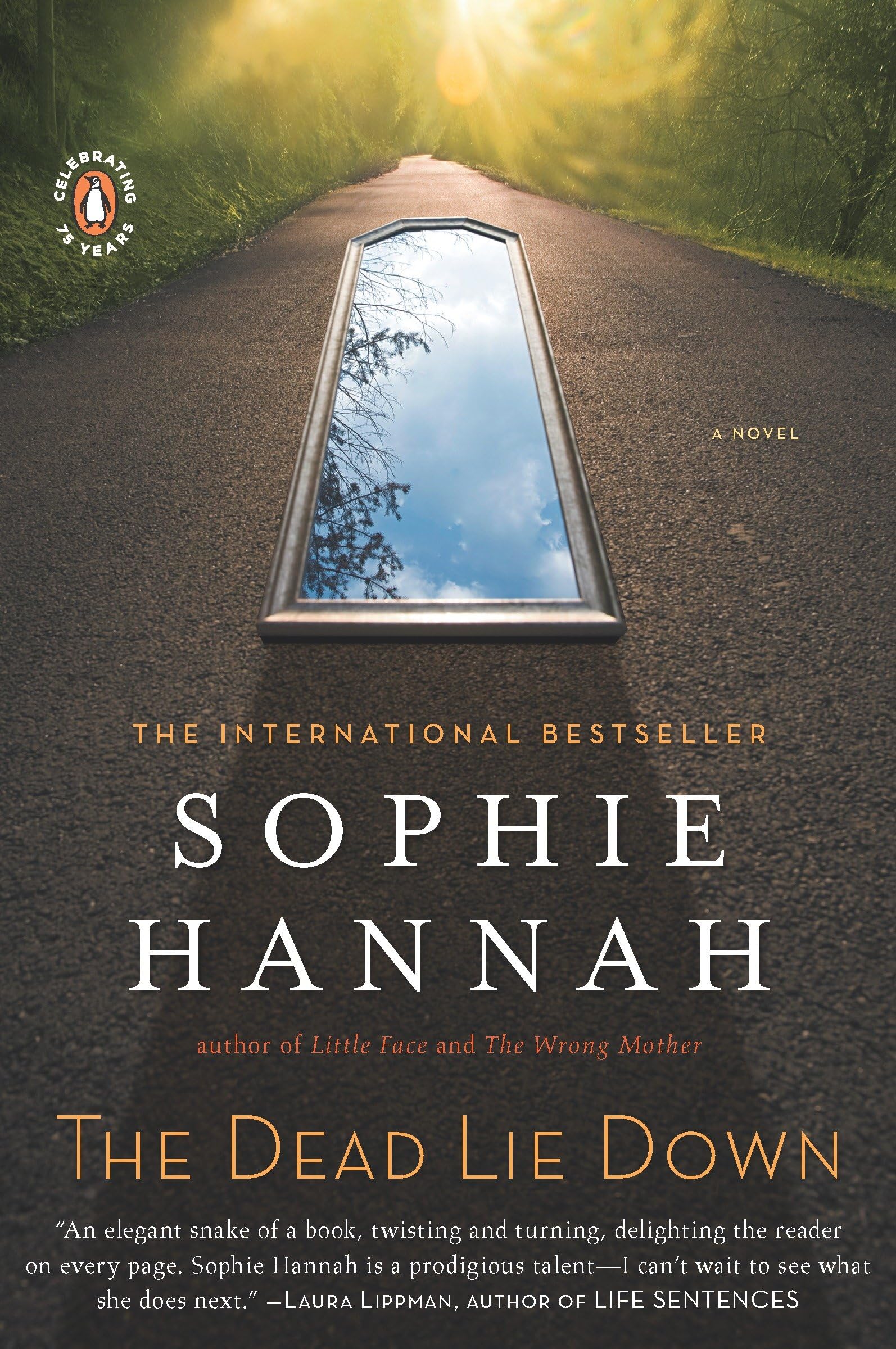
A heart-stopping novel of psychological suspense from the internationally bestselling author of The Wrong Mother and The Other Woman’s House Ruth Bussey once did something wrong – horribly wrong – and was nearly destroyed by her punishment. Now, she has tentatively rebuilt her life and unexpectedly found love with a man named Aidan Seed. But Aidan also has a secret, and one day he confides in Ruth: years ago, he killed a woman named Mary Trelease. Ruth's initial horror turns to confusion when she realizes that she knows Mary Trelease, and Mary is very much alive. So why does Aidan insist that she’s dead? The fourth book in Sophie Hannah’s beloved Zailer and Waterhouse series, The Dead Lie Down is a sophisticated, addictive page-turner that will appeal to fans of Laura Lippman and Tana French. Sophie Hannah and Tana French: Author One-on-One Sophie: Someone said to me recently that they found it strange we openly say we like each other's work, when we should surely regard each other as "the competition." I found this idea really weird. As far as I'm concerned, the only competition any writer ought to be interested in is the competition between good writing and bad writing. So, while I get very cross and resentful when a book that I think is terrible does well, I love it when books I think are great do well--I feel that the right side, i.e. good writing, is winning the competition, which I feel benefits me as much as anyone else, because I want to live in a world where brilliant books are valued. Also, if I think a book is better than anything I could write, then I want it to do better than my books in order to reflect that. I suppose what I'm saying is that I want there to be a meritocracy of literature. Would you agree or disagree? Tana: I'd definitely love a meritocracy of literature--both for reasons of principle (same as you, I get jumping-up-and-down outraged if I see a good book sidelined in favor of what I consider a crap one) and for very practical reasons. It sort of ties in with why I've never seen you as "the competition." I love what you write. I think it's good. If someone picks up one of your books and reads it and likes it, I think it'll whet their appetite for good books--and, specifically, for good psychological crime. That makes them more likely, not less, to go looking for more and wind up reading something of mine. Sophie, is there anything you wouldn’t write about for ethical reasons? I think mystery’s one of the most moral genres--it’s all about exploring right and wrong, finding truth, achieving justice, how these things are never black and white. We spend a lot of our time thinking about the more dangerous far reaches of morality and immorality. Any ethical lines you wouldn’t cross as a writer? Sophie: There are no subjects that I think writers shouldn't write about--anything is a valid subject for fiction, and it's possible to handle any subject sensitively or insensitively. I think the ethics are in the way a writer treats a subject, not inherent in the subject itself. Having said that, there are things I don't think I could write about because I find them too horrible--the main one that springs to mind is state-sanctioned execution. If a film or book contains legal execution, I can't watch/read it. I find it too upsetting. The other subject I find too upsetting is fatal illness, especially when the terminally ill person is the loved one of the narrator--so, I guess since I wouldn't read about those things, I wouldn't write about them either! How about you, is there anything you wouldn't write about? Tana: The one huge ethical issue, for me, is making sure that I give murder and murder victims the weight they deserve. I don't ever want to write something where the victim is simply a prop that's necessary in order for the story to get under way. Murder, taking another human being's life, is so earth-shatteringly huge: it doesn't just take one life, it affects everyone who comes into contact with it--families, friends, detectives working on the case, people who knew the killer.... I feel like using something so immense as a throwaway plot point would be unethical and cheap. I've got a responsibility to show that immensity, as far as possible. I can't see myself ever writing about child abuse, but that's partly because it became so common in mystery books for a while there--either child abuse was the big secret that was revealed at the end, or else it was the killer's reason/excuse for murder. It got cheap. Apart from that, though, I'm not sure I can see myself avoiding a subject (not permanently, anyway) simply because it wrecks my head too badly. One of the reasons I write crime is in a attempt to understand things that I simply can't get my head around--how one human being can kill another, or deliberately damage another (like the sociopath in one of the books). So I tend to come back to the things that horrify me most, trying to understand them by writing abo