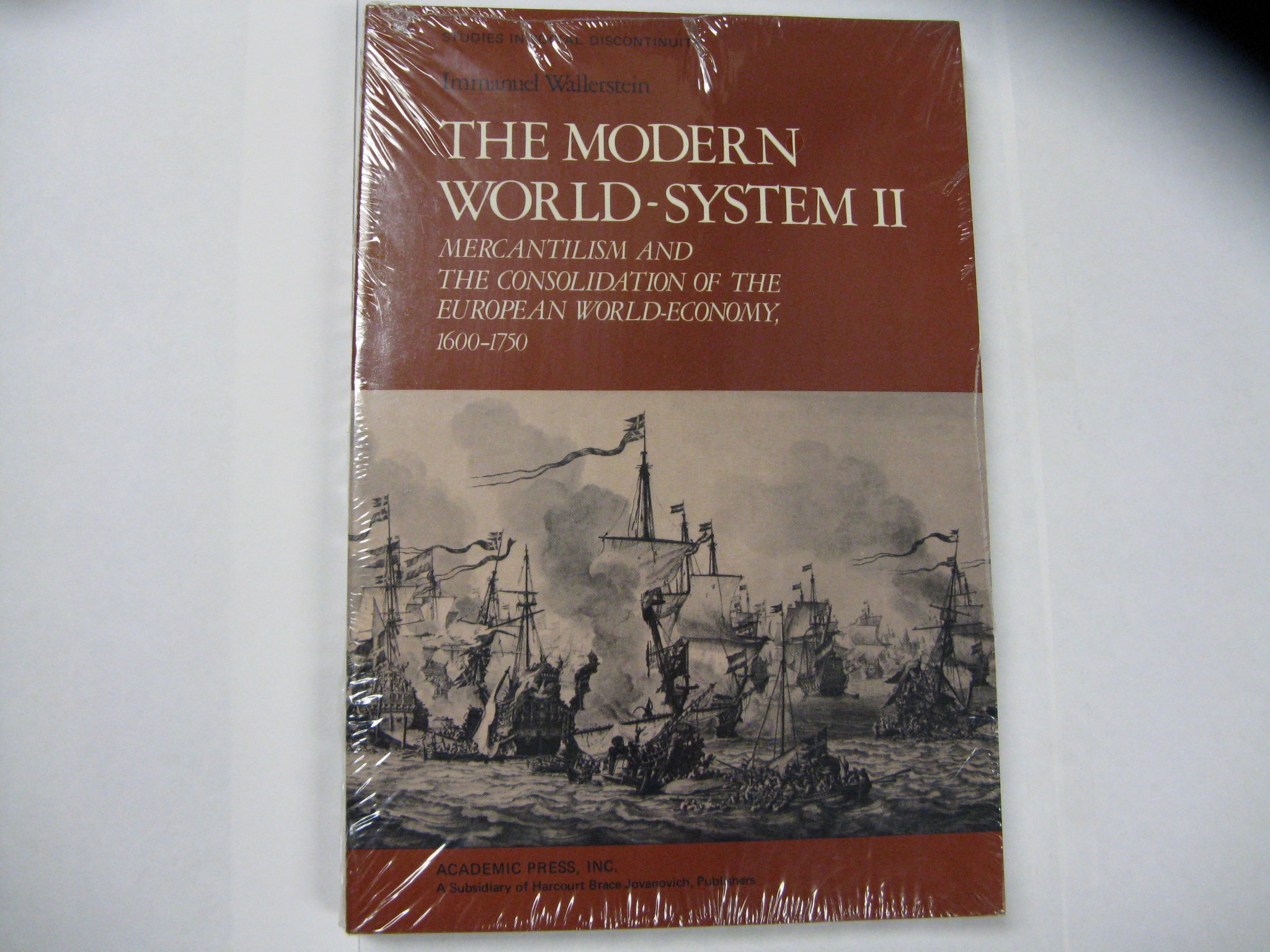
This book covers the consolidation of the European world-economy during the seventeenth century. "An indispensable acquisition for academic libraries, upper-division and above, mainly because of the ongoing discussion that was initiated with the publication of Volume I." --CHOICE "[Wallerstein's] greatest strength in this enterprise is his prodigious knowledge of the literature. The bibliography at the end of the books is not only impressive and useful but is also reflected in the footnoting of each passage... [this work] commands respect and justifies interest in the volumes to follow." --SOCIETY "In our age of high specialization, Wallerstein's ambitious yet judicious synthesis will command the respect of any scholar who has tried to grapple with the peculiarly intractable problems of the period." --JOURNAL OF MODERN HISTORY "The Battle in the Sound between the Dutch and Swedish Fleets in 1658," by Willem van de Velde, the Elder. Van de Velde was a leading painter of marine life who was given a ship in 1630 by the States of Holland in order to observe and paint sea battles. By 1665, when he painted this grisaille, he had moved to England and was working for Charles II. The Modern World-System II Mercantilism and the Consolidation of the European World-Economy 1600–1750 By Immanuel Wallerstein UNIVERSITY OF CALIFORNIA PRESS Copyright © 2011 The Regents of the University of California All rights reserved. ISBN: 978-0-12-785924-8 Contents List of Illustrations, ix, Acknowledgments, xi, Prologue to the 2011 Edition, xiii, INTRODUCTION: CRISIS OF THE SEVENTEENTH CENTURY?, 2, 1. THE B-PHASE, 12, 2. DUTCH HEGEMONY IN THE WORLD ECONOMY, 36, 3. STRUGGLE IN THE CORE—PHASE I! 1651–1689, 74, 4. PERIPHERIES IN AN ERA OF SLOW GROWTH, 128, 5. SEMIPHERIPHERIES AT THE CROSSROADS, 178, 6. STRUGGLE IN THE CORE—PHASE II: 1689–1763, 244, Bibliography, 290, Index, 350, CHAPTER 1 THE B-PHASE For Slicher van Bath, the fundamental distinguishing characteristic of the periods of agricultural expansion and contraction in Europe since the Carolingian era is the rise and fall in the price of cereals, vis-à-vis other merchandise and wages. It was a question of favorable or unfavorable terms of trade for cereals. He sees a contraction, meaning unfavorable terms of trade, for cereals in the period from 1600 (or 1650) to 1750. It is important to underline this definition of contraction, because the relative decline of the price of wheat in Slicher van Bath's belief, is far more important than its absolute decline. Side by side with a shift in the terms of trade (avoiding, for the moment, all suggestion of causal sequence) is what K. Glamann calls a turning point around 1650 in "the great east–west grain trade," apparently occurring because "southern and western Europe [seemed] to have become more self-sufficient in grain." This self-sufficiency is attributed to an "increased production of foodstuffs in western Europe during the second half of the seventeenth century, coinciding with a general stagnation of population," resulting presumably in oversupply. However, Glamann also notes that at this same time "Europe was glutted with pepper." But how can oversupply be suggested when the problem of the times was presumably too little food? Schöffer speaks of "permanent, sometimes latent, structural phenomena" existing in Europe "from the disasters of the fourteenth century until far into the eighteenth century," primarily "the continuous tension between food production and food distribution on the one hand and the population's food requirements on the other." The result was "a situation where malnutrition was endemic, hunger often epidemic." Domenico Sella sees the well-being of the early modern period as dependent "on whether food supplies kept pace with population," yet others speak of production rising faster than population. Clearly we have an anomaly that can only be resolved with a clearer notion of the sequence of events. Let us see first what other events occurred. Certain agronomic shifts are reported for the seventeenth century: the process of land reclamation was at least slowed down, probably stopped, possibly reversed. Unlike the sixteenth and eighteenth centuries, which "invented land" (in Chaunu's felicitous image), the seventeenth century, especially after 1650, was a time of "consolidation," but a consolidation "without merit." In addition to the cessation of expansion of land area, the average yield ratio of cereals fell throughout Europe in the period between 1600 and 1699, to a greater degree for barley and oats than for wheat and rye, and fell more sharply in central, northern, and eastern Europe than in western Europe. De Maddalena calls this fall of yield ratios "a remarkable phenomenon." Another major agronomic shift was in the choice of crops to be cultivated: first, a shift in the use of land for cereals to its use for pasturage in the cooler areas and for wine in the wa