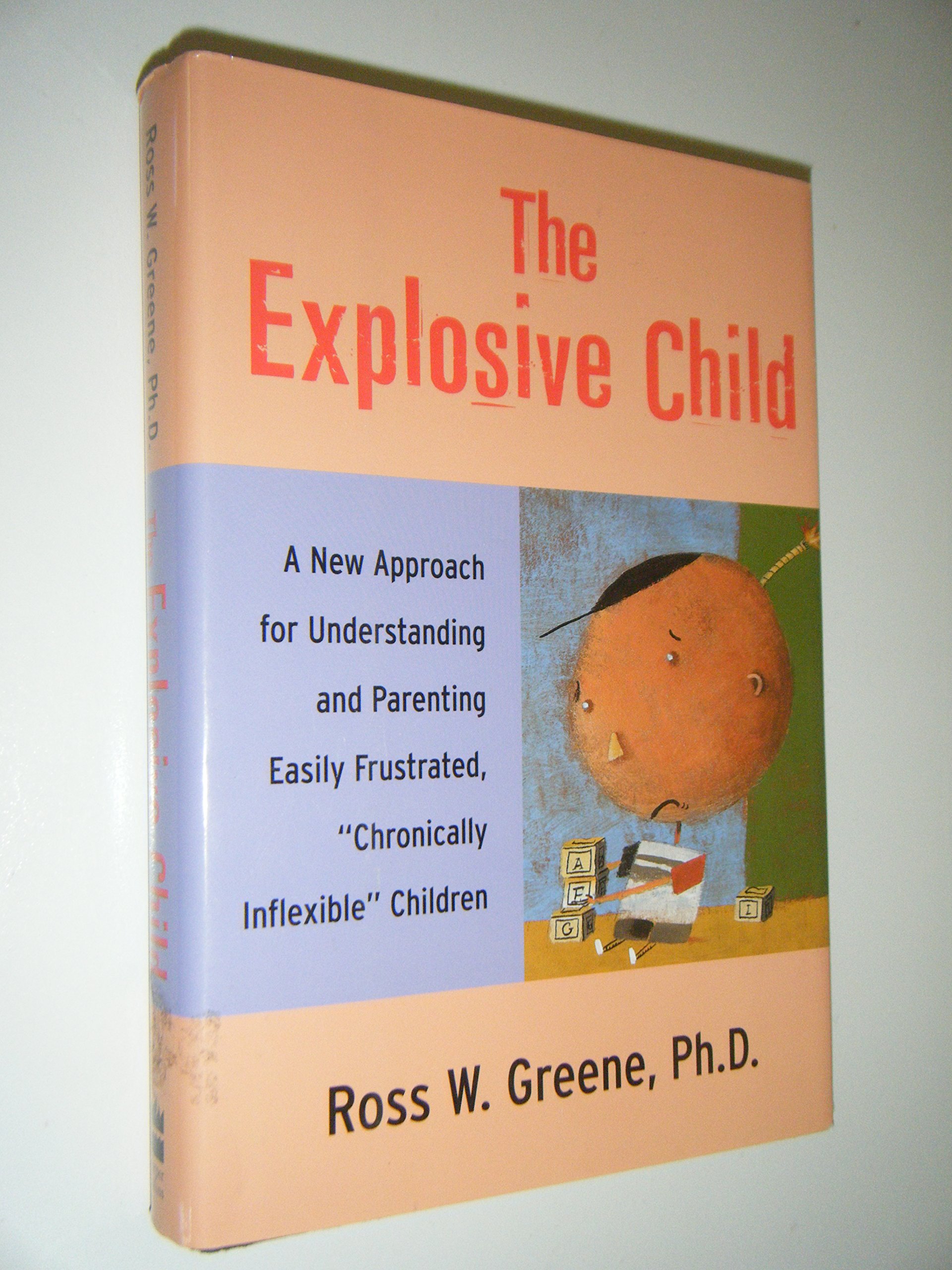
The groundbreaking “New Approach for Understanding and Parenting Easily Frustrated, Chronically Inflexible Children,” The Explosive Child by Ross W. Greene, Ph.D., has been updated and revised to include the latest research. Dr. Greene is Associate Clinical Professor in the Department of Psychiatry, Harvard Medical School and the originator of the Collaborative Problem Solving approach to the treatment and study of children with social, emotional, and behavioral challenges. With The Explosive Child he offers an indispensable helping hand to parents who may feel overwhelmed by having to deal with children whose reactions to everyday stimuli may be far more extreme than normal. Flexibility and tolerance are learned skills, as any parent knows if they've seen an irascible 2-year-old grow into a pleasant, thoughtful, and considerate older child. Unfortunately, for reasons that are poorly understood, a few children don't "get" this part of socialization. Years after toddler tantrums should have become an unpleasant memory, a few unlucky parents find themselves battling with sudden, inexplicable, disturbingly violent rages--along with crushing guilt about what they "did wrong." Medical experts haven't helped much: the flurry of acronyms and labels (Tourette's, ADHD, ADD, etc.) seems to proffer new discoveries about the causes of such explosions, when in fact the only new development is alternative vocabulary to describe the effects. Ross Greene, a pediatric psychologist who also teaches at Harvard Medical School, makes a bold and humane attempt in this book to cut through the blather and speak directly to the (usually desperate) parents of explosive children. His text is long and serious, and has the advantage of covering an enormous amount of ground with nuance, detail, and sympathy, but also perhaps the disadvantage that only those parents who are not chronically tired and time-deprived are likely to get through the entire book. Quoted dialogue from actual sessions with parents and children is interspersed with analysis that is always oriented toward understanding the origins of "meltdowns" and developing workable strategies for avoidance. Although pharmacological treatment is not the book's focus, there is a chapter on drug therapies. --Richard Farr “ The Explosive Child is a must for the many parents, teachers, and professionals who attempt to guide, teach, and work with difficult, hard-to-manage, and easily frustrated children. . . . A must-read for our children’s sake and ours.” — Thomas H. Ollendick “A truly remarkable book. . . . Dr. Greene skillfully provides us with both a framework and practical interventions for minimizing struggles with these children and enhancing their development. . . . What comes across on every page of this wonderful book is a genuine caring and compassion for these youngsters and their a families.” — Robert Brooks, Ph.D. , author of The Self-Esteem Teacher “An insightful, sensitive portrayal of children who need help—and how to help them.” — Myrna B. Shure “A user-friendly, practical guide for parents trying to help difficult, explosive children. This book will be of enormous benefit to such children and their families.” — Michael Jellinek “All parents should read this book, especially those with children who are out of control. Ross Greene presents a loving, rational, and research-based approach to dealing with problems that most parents have either felt were their own fault or were unsolvable. I could not recommend this book more highly.” — Edward Hallowell, M.D., author of Driven to Distraction We've all seen them: children who explode when they're told to do something or when things don't go their way. The ones who completely lose control and become verbally and physically aggressive. Spoiled, stubborn, manipulative children. Right? Not so fast. These labels suggest that the behavior if such children is planned and intentional, and popular reward-and-punishment strategies are typically used to teach and motivate them to behave more appropriately. But for a significant number of these children, the standard approach doesn't always work. Such children are easily frustrated and extremely inflexible. They get "stuck" over seemingly simple requests, benign issues, and sudden changes in plans. They may be very anxious, irritable, and volatile. They may have difficulty telling you what they're frustrated about or thinking through potential solutions to problems. In clinical terms, they may be diagnosed with any of a variety of psychiatric disorders, including oppositional-defiant disorder, attention-deficit/hyperactivity disorder (ADHD), Tourette's disorder, depression, and bipolar disorder. If this sounds like your child, you're probably feeling frustrated, overwhelmed, guilt-ridden, exhausted, and hopeless. N